

 English
 Français
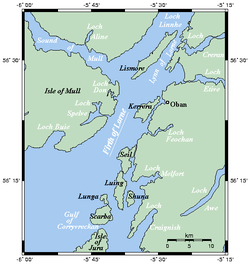
Firth of Lorn
Le Firth of Lorn, parfois appelé de manière non officielle Firth of Lorne, en gaélique écossais An Linne Latharnach, est un firth situé dans l'Ouest de l'Écosse, au Royaume-Uni. Il constitue une avancée de l'océan Atlantique dans les Hébrides intérieures, séparant l'île de Mull à l'ouest et le reste de l'Écosse à l'est, notamment les îles Slate. Il communique au nord avec le détroit de Mull, le Lynn of Lorne ainsi que le Loch Linnhe et au sud avec l'océan Atlantique.
Nearby Places View Menu

4.1 km
Seil
Seil (; Scottish Gaelic: Saoil, Scottish Gaelic pronunciation: [ˈs̪ɯːl]) is one of the Slate Islands, located on the east side of the Firth of Lorn, 7 miles (11 kilometres) southwest of Oban, in Scotland. Seil has been linked to the mainland by bridge since the late 18th century.
The origins of the island's name are unclear and probably pre-Gaelic. It was a part of the kingdom of Dalriada in the 7th century but by the 16th century, Seil seemed to have been primarily agricultural in nature. It became part of the estates of the Breadalbane family and in the early 18th century they began to exploit the rich potential of the Neoproterozoic slate beds. The excavations from the island's quarries were exported all over the world during the course of the next two centuries. Today, the economy is largely dependent on agriculture and tourism.
The "dangerous seas" of the Firth of Lorn have claimed many lives and there are several shipwrecks in the vicinity of Seil. Kilbrandon Church has fine examples of stained glass windows and an association with St Brendan.

4.4 km
Ellenabeich
Ellenabeich (Scottish Gaelic: Eilean nam Beitheach, meaning "island of the birchwoods.") is a small village on the isle of Seil (Scottish Gaelic: Saoil) – an island on the east side of the Firth of Lorn, 7 miles (11 km) southwest of Oban, in the council area of Argyll and Bute, Scotland. It is a former slate-mining village and is where parts of Ring of Bright Water were filmed. Seil is one of the Slate Islands.
The village gets its name from the former slate island within proximity of the village, called Eilean nam Beitheach. The island was mined out of existence and its name is now the current Scottish Gaelic name of the village.
The village is sometimes called "Easdale" because of its proximity to the island of that name. In the village can be found:
The Ellenabeich Heritage Centre which was opened in 2000 and is run by the Scottish Slate Islands Heritage Trust. The centre has been created in a former slate quarry-worker's cottage and has 19th century life displays, matters relating to the local dominate industry of slate quarrying as well information relating to the local flora, fauna and the area's geology.
Highland Arts exhibited the works of the late C. John Taylor, a poet, artist, and composer; it closed in November 2017.
The local slate contains pyrites or "fool's gold". The former slate works' manager's house was a hotel for a number of years, trading as the Easdale Inn; this has now been converted back into a private residence.
A small ferry runs from Ellenabeich to Easdale.

4.5 km
Clachan Bridge
The Clachan Bridge (also known as the Bridge over the Atlantic) is a simple, single-arched, hump-backed, masonry bridge spanning the Clachan Sound, 13 kilometres (8 mi) southwest of Oban in Argyll and Bute, west of Scotland. It links the west coast of the Scottish mainland to the island of Seil.
The bridge was originally designed by John Stevenson of Oban (and not by Thomas Telford as sometimes quoted) and was built between 1792 and 1793 by engineer Robert Mylne. The original design had two arches, but it was finally built with a single high arch, of roughly 22 metres (72 ft) span and about 12 metres (39 ft) above the bed of the channel, to allow the passage of vessels of up to 40 tonnes (39 long tons) at high tide. The bridge is still in use today, forming part of the B844 road, and is in the care of Historic Scotland.
Because the Clachan Sound connects at both ends to the Atlantic Ocean, and might therefore be considered part of that ocean, the bridge came to be known as the Bridge over the Atlantic (Scottish Gaelic: a' Dhrochaid thar a' Chuain Siar). Such an appellation has also been applied to certain other bridges having similar situations, such as the Brúgvin um Streymin in the Faroe Islands and between Lewis and Great Bernera in the Outer Hebrides.
4.6 km
Easdale
Easdale (Scottish Gaelic: Eilean Èisdeal) is one of the Slate Islands, in the Firth of Lorn, Scotland. Once the centre of the Scottish slate industry, there has been some recent island regeneration by the owners. This is one of the smallest of the inhabited islands of the Inner Hebrides and is home to traditional white-washed cottages and disused slate quarries. The island supports a successful arts programme and an award-winning museum and is without cars or streetlights.
A ferry sails from Easdale to Ellenabeich on the nearby island of Seil (Gaelic: Saoil), which is separated from Easdale by only a narrow channel. Confusingly, Ellenabeich is sometimes known as 'Easdale' as a result of its connections with the island.

4.8 km
Croggan
Croggan is a small scattered settlement on the Loch Spelve sea loch, in the south of the Isle of Mull, Argyll and Bute, Scotland. It is located in the Torosay parish. There is a beach.
The nearest village is Lochbuie.
There is a former school and schoolhouse.