


Battle of Nyborg
The Battle of Nyborg took place between Sweden and the combined forces of Denmark, Dutch naval forces under Michiel de Ruyter, troops of Brandenburg-Prussia, and Polish–Lithuanian Commonwealth forces under Stefan Czarniecki. The battle was engaged on 14 November 1659 at Nyborg on the Danish island of Funen. Nyborg was the final major battle of the Dano-Swedish War of 1658 to 1660.
Book your tour near
Battle of Nyborg
Book Now
4.5
in partnership with
GetYourGuide.com
Gallery



Sponsored
Location

3.5 km
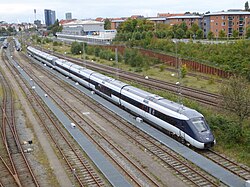
The Great Belt Bridge rail accident occurred on 2 January 2019 on the Great Belt Fixed Link in Denmark when a passenger train collided with a semi-trailer from or on a passing freight train. The Great Belt Fixed Link is an 18 km long bridge–tunnel connection between the Danish islands of Zealand and Funen, and the accident happened on the West Bridge, near Funen. The accident happened during a storm, which had closed down the bridge for road traffic, but not for rail traffic. Eight passengers were killed, all Danish citizens, and 16 were injured, making it the deadliest rail accident in Denmark since 1988.
An early investigation found that in some cases, wagons similar to the one involved in the accident failed to lock the semi-trailers in place. A full investigation was published several months later and it confirmed the earlier results. The Danish Transport Authority temporarily banned this kind of wagon until extra locking procedures were put in place, and have tightened the rules for freight on the bridge during windy weather. Shortly after, temporary measures to avoid similar accidents were introduced throughout Europe and permanent measures were introduced in early 2020.
In January 2021 the use of pocket wagons was again suspended in Denmark, following an incident on the same bridge when a semi-trailer had shifted position, and had protruded beyond the side of its freight wagon.

6.5 km
Nyborg railway station is a railway station serving the town of Nyborg on the eastern part of the island of Funen, Denmark. It is located in the eastern part of the town, about 1 km east of the historic town centre.
Nyborg station is located on the main line Copenhagen–Fredericia railway from Copenhagen to Funen and Jutland. The station offers direct InterCity services to Copenhagen, Funen and Jutland, regional rail services to Copenhagen and Odense operated by the national railway company DSB.
The current station is the fourth station in Nyborg. The first station in the town opened in 1865 as the eastern terminus of the Funen Main Line between Nyborg and Middelfart via Odense. The original station was located closer to the harbour from where there was connection via railway ferry across the Great Belt to Korsør on the island of Zealand. Nyborg station was moved to its current location in 1997 with the opening of the railway section of the Great Belt Bridge.

6.7 km
Korsbrødregården is the ancient compound of the Knights Hospitaller in the Danish city of Nyborg, founded as a dependency of their castle and hospital in Antvorskov. It is situated south of Vor Frue Kirke just across the small street named Korsbrødregade. The Brick Gothic building has been erected at about 1400 and was first mentioned in 1405. It consists of two ailes. the northern one has a large vaulted cellar with two naves.
After 1613, the building was enlarged, and one of its stepped gables was changed for a Renaissance volute gable.
6.9 km
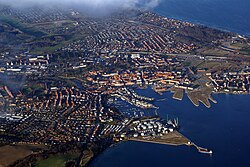
Nyborg is a city in southern Denmark, located in Nyborg Municipality on the island of Funen and with a population of 17,990. It is the easternmost settlement on Funen. By road, it is located 34 km east of Odense, 35 km north of Svendborg and 21 km south of Kerteminde. It also connects to Korsør through the Great Belt Bridge. Nyborg is the seat of Nyborg Municipality, and until 1793 it was also the seat of Nyborg County.
The city was founded in the 1200s, built up around Nyborg Castle. The castle holds a central place in Nyborg geographically, historically and culturally.
Book your tour near
Battle of Nyborg
→
Swedish Imperial field marshal Philip Florinus of Sulzbach, leading the vanquished Swedish forces, was forced to save his own life by fleeing under cover of night. The battle is considered one of the most important Danish victories of the war.