


La tour de la cloche de Nankin, dans le Jiangsu, en Chine, est un élément traditionnel chinois de type tour de la cloche, généralement associé à une tour du tambour.
Gallery


Sponsored
Location
1 explorer visited this place

197 m
Nanjing is the capital of Jiangsu, East China. The city, which is located in the southwestern corner of the province, has 11 districts, an administrative area of 6,600 square kilometres, and as of 2021 a population of 9,423,400.
Situated in the Yangtze River Delta, Nanjing has a prominent place in Chinese history and culture, having served as the capital of various Chinese dynasties, kingdoms and republican governments dating from the 3rd century to 1949, and has thus long been a major center of culture, education, research, politics, economy, transport networks and tourism, being the home to one of the world's largest inland ports. The city is also one of the fifteen sub-provincial cities in the People's Republic of China's administrative structure, enjoying jurisdictional and economic autonomy only slightly less than that of a province. It has also been awarded the title of 2008 Habitat Scroll of Honor of China, Special UN Habitat Scroll of Honor Award and National Civilized City. Nanjing is also considered a Beta city classification, together with Chongqing, Hangzhou and Tianjin by the Globalization and World Cities Research Network, and ranked as one of the world's top 100 cities in the Global Financial Centres Index.
As of 2021, Nanjing has 68 institutions of higher learning, including 13 double-first-class universities, ten 111-plan universities, eight 211 universities, and 97 academies. Nanjing University, which has a long history, is among the world's top 10 universities ranked by the Nature Index. The ratio of college students to the total population ranks No.1 among large cities nationwide. Nanjing has the fifth-largest scientific research output of any city in the world. As of 2024, it has been ranked as the world's second most prolific scientific research center in earth and environmental sciences and the world's third most prolific scientific research center in chemistry and physical sciences, according to the Nature Index.
Nanjing, one of the nation's most important cities for over a thousand years, is recognized as one of the Four Great Ancient Capitals of China. It has been one of the world's largest cities, enjoying peace and prosperity despite various wars and disasters. Nanjing served as the capital of Eastern Wu, one of the three major states in the Three Kingdoms period; the Eastern Jin and each of the Southern dynasties, which successively ruled southern China from 317 to 589; the Southern Tang, one of the Ten Kingdoms; the Ming dynasty when, for the first time, all of China was ruled from a city, one city; and the Republic of China, serving as the internationally recognized capital of China and the seat of the central government of China under the Kuomintang, until the government's relocation to Taipei at the conclusion of the Chinese Civil War. The city also served as the seat of the rebel Taiping Heavenly Kingdom and the Japanese-installed collaborationist regime of Wang Jingwei during the Second Sino-Japanese War. It suffered devastating atrocities in both conflicts, most notably the Nanjing Massacre of 1937–38.
Nanjing became the capital city of Jiangsu province in 1952, after serving as a Direct-administered Municipality from 1949 to 1952 following the establishment of the People's Republic of China. It has many important heritage sites, including the Presidential Palace, Sun Yat-sen Mausoleum and Ming Xiaoling Mausoleum. Nanjing is famous for human historical landscapes, mountains and waters such as Fuzimiao, Ming Palace, Chaotian Palace, Porcelain Tower, Drum Tower, Stone City, City Wall, Qinhuai River, Xuanwu Lake and Purple Mountain. Key cultural facilities include Nanjing Library, Nanjing Museum and Jiangsu Art Museum.

230 m
Zifeng Tower is a 450-meter supertall skyscraper in Nanjing, Jiangsu. The 66-story building completed in 2010 comprises retail and office. Floors 49/71 feature a hotel, numerous restaurants, and a public observatory. The tower's stepping is functional; office, hotel, and retail are located above grade, while the restaurants and the public observatory are housed at the top of the tower. The building is currently the tallest in Nanjing and Jiangsu province, the eleventh tallest in China and the twentieth tallest in the world.
Architectural firm Skidmore, Owings and Merrill designed the building, led by Adrian Smith. The Tower occupies an area of 18,721 square meters. The Nanjing Greenland InterContinental Hotel is located within the tower.

538 m
Nanjing University is a public university in Nanjing and Suzhou, Jiangsu, China. It is affiliated and sponsored by the Ministry of Education. The university is part of Project 211, Project 985, and the Double First-Class Construction. The university is a member of the C9 League.
Established in 1902 as Sanjiang Normal School, Nanjing University underwent a number of name changes, such as Nanjing Higher Normal School, National Southeastern University and National Central University, until it was renamed Nanjing University in 1950. It merged with the University of Nanking in 1952.
Nanjing University has four campuses: the Xianlin campus in the northeast of Nanjing, the Gulou campus in the city center of Nanjing, the Pukou campus in the Pukou District of Nanjing, and the Suzhou campus in the city of Suzhou.
541 m
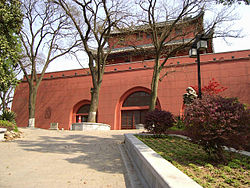
The Drum Tower of Nanjing on Gulou Mountain in the Gulou District of downtown Nanjing, was first built in the 15th year of the reign of Hongwu, founding emperor of the Ming Dynasty.
The Drum Tower, which is an important part of Drum Tower Park, is 44 meters long, 22 meters wide and 30 meters high. Its shape is like a Chinese traditional city gate, with a square foundation pedestal made of stone. In the pedestal, there are three archways: one larger in the middle and two smaller on the each side. In the side gateways, there are four side-rooms, which were guarded by the imperial drumming officers with hundreds of soldiers during the ancient dynasty. On the pedestal is a red two-story watch tower, made of wood and bricks, which was a sacred place to hold some important imperial ceremonies, such as giving a correct time, welcoming honorable guests, offering sacrifices to the god, and others.

689 m
Gulou station is an interchange station on Line 1 and Line 4 of the Nanjing Metro. Opened on 3 September 2005 for the Line 1 portion of the station, Gulou station is among the first Nanjing Metro stations to open for passenger service. It is named for an old drum tower that serves as a local landmark nearby. The line 4 section of the station opened on 18 January 2017, with cultural exhibits lining the station's walls. Located underneath a roundabout that links to Beijing West Road, Beijing East Road, Zhongyang Road, Zhongshan Road and Zhongshan North Road, Gulou station is located near Gulou Hospital, Nanjing University's Gulou campus, and is right underneath the Zifeng Tower.
Description
Située non loin de la Tour du tambour de Nankin, il s'agit d'un pavillon hexagonal à double toit, couvert de tuiles grises, de 14,5 mètres de haut, contenant une énorme cloche. La structure actuelle date de 1889. Tout autour se trouve un joli jardin. La cloche, qui date de 1388, mesure 3,5 mètres de haut, 2,3 mètres de diamètre et pèse 23 tonnes.
Article connexe
Tour du tambour de Nankin Portail de la Chine Portail de l’architecture et de l’urbanisme