

 English
 Français

Alloa
Alloa est une ville (et ancien burgh) écossaise, située dans le council area et région de lieutenance du Clackmannanshire, dont elle est la capitale administrative. La ville est située à l'est de Stirling sur la rive nord de la Forth. De 1975 à 1996, elle était la capitale administrative du district de Clackmannan, au sein de la région Central.
Nearby Places View Menu
58 m
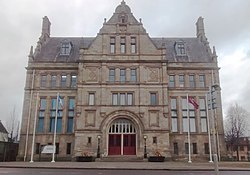
Alloa Town Hall
Alloa Town Hall is a municipal building in Marshill, Alloa, Scotland. The structure, which was the meeting place of Alloa Burgh Council, is a Category C listed building.

168 m
County Buildings, Alloa
County Buildings is a municipal structure in Drysdale Street, Alloa, Clackmannanshire, Scotland. The structure, which was the headquarters of Clackmannanshire County Council and is currently used as courthouse, is a Category B listed building.
180 m
Alloa
Alloa (AHL-oh-wuh, Received Pronunciation ; Scottish pronunciation /ˈaloʊa/; Scottish Gaelic: Alamhagh, possibly meaning "rock plain") is a town in Clackmannanshire in the Central Lowlands of Scotland. It is on the north bank of the Forth at the spot where some say it ceases to be the River Forth and becomes the Firth of Forth. Alloa is south of the Ochil Hills on the western Fife peninsula, six miles (ten kilometres) east of Stirling and 13 miles (21 km) west of Dunfermline; by water Alloa is 25 miles (40 km) from Granton.
The town, formerly a burgh of barony, is the administrative centre of Clackmannanshire Council. Historically, the economy relied heavily on trade between Glasgow and mainland Europe through its port. This became increasingly uncompetitive and the port stopped operating in 1970. The local economy is now centred on retail and leisure since the closure of major industries; only one brewer and one glassmaker survive today. Parochially, Alloa was linked with Tullibody. The towns are now distinct, albeit with Lornshill in the middle, and Alloa is about twice the size of its north-western neighbour. The population of Alloa was estimated to be approximately 20,730 residents in 2016.

289 m
St Mungo's Parish Church
The church is named after Saint Mungo (also known as Saint Kentigern), patron saint and founder of the city of Glasgow. It belongs to the Church of Scotland Presbytery of Stirling and serves the parish of Alloa. A chapel dedicated to St Mungo is thought to have been erected during the fourteenth or fifteenth-century, which became dependent upon the Parish of Tullibody. Alloa had grown into a parish in its own right by 1600 when the Act of Assembly united the two parishes. In 1680, the original chapel was rebuilt and enlarged. The current church replaces the old parish church from the seventeenth-century which had been deemed much too small for the congregation for over seventy years and was declared ruinous and unsafe in August 1815. The condition of the old church was so bad that services were often being held in the open air rather than risking injury to the congregation The decision was finally made to abandon the old building and find a site for a new parish church. The Erskine family donated land at Bedford Place and work on the new St Mungo's church began in 1817. The church congregation temporarily worshipped in the Tabernacle until the completion in 1819 of the new church. Since land was judged at the time to have too great a value to the living to be set aside for the dead, no graveyard was planned or added to the new church. The more elaborate scale and design of the new building was intended to reflect the increased size and prosperity of the nineteenth-century congregation. The church was one of the largest in Scotland at the time it was built.
494 m
Alloa goods station (Caledonian Railway)
Alloa goods station was a goods railway station operated by the Caledonian Railway in Alloa, Clackmannanshire, Scotland, from 1885 to 1980.
The station was the planned terminus of the Alloa Railway as authorised by Parliament in 1884 when the Caledonian Railway absorbed the Alloa Railway. The station opened on 1 October 1885, when the complete line from Dunmore Junction on the South Alloa branch opened. The station was located on the western side of Glasshouse Loan to the north of Craigward Cooperage.
Passenger traffic on this line used the main Alloa station over a North British Railway connecting line.
The station closed in 1980, most of the site now making up a bus depot.