

 English
 Français

Sheffield General Cemetery
The General Cemetery in the City of Sheffield, England opened in 1836 and closed for burial in 1978. It was the principal cemetery in Victorian Sheffield with over 87,000 burials. Today it is a listed Landscape (Grade II*) on the English Heritage National Register of Historic Parks and Gardens. It is also a Local Nature Reserve. It is owned by the City of Sheffield and managed on behalf of the city by a local community group, the Sheffield General Cemetery Trust.
Nearby Places View Menu
248 m
Sharrow
Sharrow is a suburb of Sheffield located directly southwest of Sheffield city centre. The district lies within the Nether Edge and Sharrow ward of the city.
The inner city area of Sharrow situated around London Road is distinct from the more leafy suburbs of Sharrow Head, and Sharrow Vale.
Sharrow Ward's back to back terraced housing in Little Sheffield was redeveloped in the 1970s to provide modern, high density accommodation for the area's working class population.
With the economic resurgence of Sheffield in the late 1990s, Sharrow has benefited from considerable inward investment both in improved housing stock and through development of local initiatives such as the small business enterprise unit at Sheffield United F.C.'s Bramall Lane ground in nearby Highfield.
Until June 2004 Sharrow was also the name given to one of Sheffield's electoral wards which included Sharrow proper and a number of surrounding districts. This diverse ward contained 17,897 people in the 2001 UK Census subdivided as follows:
White: 69.0%
Asian: 16.3%
Black: 7.5%
Chinese or other: 4.2%
Mixed: 3.0%
This diversity is celebrated by some with the Sharrow Festival, a multi-cultural, multi-arts event showcasing local talent and fostering a spirit of pride in the local community. The annual Sharrow Lantern Carnival is the other cultural highlight in the area, and is held in April.
372 m
Wilsons of Sharrow
Wilsons of Sharrow, now named Wilsons & Company (Sharrow) Ltd, based at Sharrow Mills in the Sharrow district of Sheffield, United Kingdom, is a manufacturer of snuff tobacco since 1737. Since 1982 Wilsons now also manufactures the renowned Fribourg & Treyer snuff blends who were producing snuff since 1720.
In the early 1740s, Joseph Wilson succeeded his father Thomas Wilson, a shearsmith, as tenant of Sharrow Mills (then a cutlers wheel). The mill suffered a fire in 1746, when his stock in trade included "tobacco snuff".
In 1833, Joseph and Henry Wilson parted company with their cousins William and George (who retained Sharrow Mills), setting up a rival business at Westbrook Mill nearby on Sharrowvale Road. That remained a family business incorporated as Joseph and Henry Wilson Ltd in 1895. It remained in family ownership until 1953, when its elderly proprietors sold the business to Imperial Tobacco. Its archives are now deposited in the Sheffield Archives.
At Sharrow Mills steam power was introduced in 1897, but the water wheel remains operational. The company is currently still owned by the Wilson family, the sixth generation since Thomas, still based at Sharrow Mills, in Sheffield.

382 m
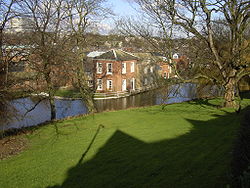
Sharrow Mills
Sharrow Mills are a collection of industrial buildings in Sheffield, England, which have been used for the production of snuff by the firm of Wilsons of Sharrow since the mid 18th century. The mills stands on the Porter Brook in the Sharrow Vale area of the city, just off Ecclesall Road.

459 m
Lantern Theatre
The Lantern Theatre (originally called The Chalet Theatre) is a small Sheffield theatre (seating capacity 84) built in 1893 and is Sheffield's oldest theatre. The Lantern Theatre is a former professional theatre venue and arts centre that houses small and mid-scale theatre, music, and comedy.
In 2011 the theatre produced their first professional co-production and in 2012 are producing their first in-house professional production of Order, a play by Martin Derbyshire. In 2012 Ruth Carney replaced Martin Derbyshire as artistic director only to leave after one season at the helm. The theatre no longer has an artistic team and is an amateur-run receiving venue run by a general manager.
The theatre is situated in the residential area of Nether Edge, England. It was originally the personal theatre of a local industrialist, however it fell into disrepair after his death. It was restored as a theatre in 1957 by Dilys Guite. The Theatre was used almost exclusively by the Dilys Guite Players (who own the theatre) for the first forty years but since then the theatre has been hired out by the players and used by a number of groups, bands and companies.