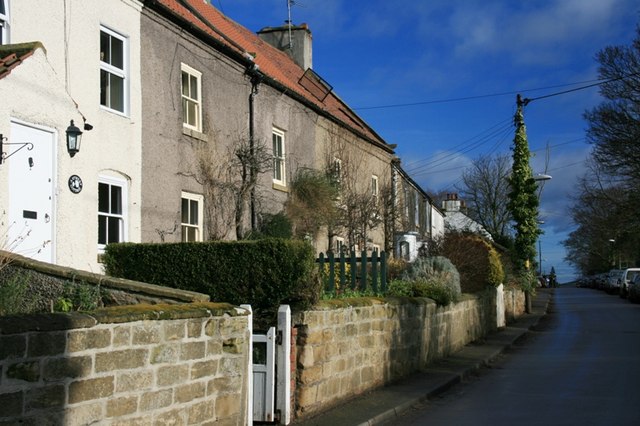
East Harlsey is a village and civil parish in the county of North Yorkshire, England. It is about 1 mile (2 km) west of Ingleby Arncliffe and the A19 and 6 miles (10 km) north-east of Northallerton. The population of the village as measured at the 2011 census was 281. From 1974 to 2023 it was part of the district of Hambleton, it is now administered by the unitary North Yorkshire Council. Within the village there is a pub called the 'Cat and Bagpipes'. St Oswald's Church, East Harlsey originated in the 12th century and is a grade II* listed building. Harlsey Hall manor house is in the centre of the village: the manor was the property of the Lascelles family from the 11th century until 1654, when it passed to the Trotter Bannerman family, and from 1825, to the Maynard family. Comedian Roy 'Chubby' Brown has a home at Harlsey Manor, to the east of East Harlsey.

Nearby Places View Menu
Location Image
229 m

St Oswald's Church, East Harlsey

St Oswald's Church is an Anglican church in East Harlsey, a village in North Yorkshire. A church was built on the site in the 12th century, from which period some of the walls survive, and there is a 15th-century window in the south wall of the chancel. It was altered in the 17th century, and the south porch and bellcote are of this date. The church was largely rebuilt in 1885 by Austin, Johnson and Hicks. It was grade II* listed in 1970. The church is built of stone with slate roofs, and consists of a nave, a north aisle, a south porch, and a chancel with a north aisle. At the west end is a double bellcote with rusticated stonework, four-centred arched bell openings, a moulded cornice, and a pyramidal gable surmounted and flanked by squat obelisks. The porch has a coped gable with three ball finials, and contains a four-centred arched opening with a chamfered surround. Inside, there is an effigy of a knight dating from the 1320s and an 18th-century monument of carved marble.
Location Image
2.0 km

West Harlsey

West Harlsey is a hamlet and civil parish in the county of North Yorkshire, England. The population as taken at the 2011 Census was less than 100. Details are included in the civil parish of Winton, Stank and Hallikeld. It is situated near the A19 road, 3 miles north-east of Northallerton. From 1974 to 2023 it was part of the district of Hambleton, it is now administered by the unitary North Yorkshire Council.
Location Image
2.0 km

Cleveland Tontine

The Cleveland Tontine is a historic building in Ingleby Arncliffe, a village in North Yorkshire, in England. In the early 19th century, a turnpike was constructed from Crathorne, to join the existing road from Thirsk to Stokesley. A group of investors decided that the junction of the two roads would be a good location for a coaching inn. They funded it with subscriptions to a tontine, which totalled £2,500. From 1827 to 1843, it was a stop for the Cleveland stagecoach, from Leeds to Redcar; from 1823 to 1830 by the Expedition, from Leeds to Newcastle upon Tyne; and from 1833 to 1840 for the Mail from Leeds to South Shields. Various shorter-lived routes also called. Before 1923, the building was converted into a private home, Ingleby House. After World War II it became a hotel and restaurant. It was purchased by Provenance Inns in 2016, which spent £1,000,000 increasing the number of bedrooms from 7 to 21. In 2025, it closed for conversion into a wedding venue and cookery school. It lies at the junction of what are now the A19 and A172 roads. The building was grade II listed in 1952. The inn is built of sandstone, the rear wing whitewashed, with hipped Lakeland slate roofs. It has two storeys and a basement, a front of five bays, and a rear wing. In the centre, a perron leads to a doorway with engaged columns, a radial fanlight in an archivolt, and a pediment, above which is a tripartite window. The outer bays contain canted bay windows, and most of the other windows are sashes. In the west wing are mullioned and transomed windows. Inside, there are three early fireplaces with original iron grates, plus a fireplace in the basement dating from about 1600, and moved from elsewhere.
Location Image
2.4 km

Ingleby Arncliffe Water Tower

Ingleby Arncliffe Water Tower is a historic structure in Ingleby Arncliffe, a village in North Yorkshire, in England. The tower was commissioned by Sir Hugh Bell, chair of the Tees Valley Water Board. A local story claims that Bell commissioned it over concerns that the local water supply would be interrupted during World War I. The tower is fed from a spring in the Cleveland Hills, about one mile away, and is stored in the tower, originally able to feed standpipes on demand. It was designed by Walter Brierley, and was completed in 1915. The building was grade II listed in 1990. It now feeds one cottage and some cattle troughs. Inside the base of the tower are stored a fire engine dating from about 1870, and an earlier funeral bier. The water tower is built of sandstone on a stepped and chamfered plinth, with quoins, a double corbel table, gargoyles, an embattled parapet, and a stone-flagged saddleback roof. There are three storeys, and the tower contains a doorway with a chamfered moulded surround, and an inscribed and dated lintel. Above it is a panel containing an achievement and a motto. The tower is surrounded by a parterre of cobbles.