


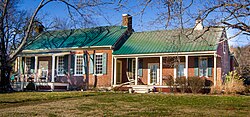
Cedarmont is a two-story brick house in Williamson County, Tennessee, near Franklin, that was listed on the National Register of Historic Places in 1984. It was deemed "a fine example of Middle Tennessee's early brick vernacular farmhouse with added Greek Revival detailing." The main portion of the house was built c.1816 and a two-story "T-plan" addition was added in c.1855.
Book your tour near
Cedarmont
Book Now
4.0
in partnership with
GetYourGuide.com
Location
1 explorer visited this place

2.3 km
The Beverly Toon House is a property in Franklin, Tennessee, United States, that was listed on the National Register of Historic Places in 1988. It has also been known as Riverside. It dates from c. 1857.
A 1988 study of Williamson County historical resources assessed that this house was one of the "best two-story vernacular I-House examples" in the county. The others highly rated were the William King House, the Alpheus Truett House, the Thomas Brown House, the Claiborne Kinnard House, and the Stokely Davis House.
3.1 km
The John Crafton House is a historic property in Franklin, Tennessee, United States, that was listed on the National Register of Historic Places on April 13, 1988.
It was built in about 1813 and added to c. 1830. It includes a hall-parlor plan and other architecture. When listed the property included one contributing building, one contributing structure and one non-contributing structure on an area of 2.8 acres.
It is a one-story a one-story, brick house and was built in two stages. The original section was built c. 1813 and includes its original nine panel door, with a main facade built in Flemish bond and side facades laid in five- and seven-course common bond. A wing was added c. 1830.
The property was covered in a 1988 study of Williamson County historical resources.

3.7 km
The McGavock–Gaines House, also known as Riverside, is a historic mansion in Franklin, Tennessee. It was listed on the National Register of Historic Places in 1988. The property then included two contributing buildings, one contributing structure, and one non-contributing building, on an area of 3.2 acres.
4.2 km
The Mordecai Puryear House is a center-hall house in Franklin, Tennessee, United States, built around 1830. Mordecai Puryear was one of the ten original investors in the National Bank of Franklin in 1871. The bank "was one of the primary financial institutions of the county" until it failed in 1926.
The property was listed on the National Register of Historic Places in 1988. At the time of listing it included two contributing buildings on an area of 4 acres. The house has been included in a tour of historic Franklin houses.
The house was built circa 1830 and was expanded twice, around 1850 and in 1907.

4.5 km
The John Henry Carothers House, also known as Ezeal Carothers House, is a property in Franklin, Tennessee that was listed on the National Register of Historic Places in 1989. When listed the property included four contributing buildings, two contributing structures, and two non-contributing buildings, on an area of 26 acres. The house is a one-and-a-half-story limestone farmhouse constructed by John Henry Carothers in 1937 with help from his son, Ezeal Carothers, following a house plan that was purchased. The men quarrired the limestone from the property.
The property was covered in a 1988 study of Williamson County historical resources.
It includes Greek Revival architecture. When listed the property included two contributing buildings (one of them a smokehouse) and a contributing site, on an area of 1.5 acres (0.61 ha).