

 English
 Français
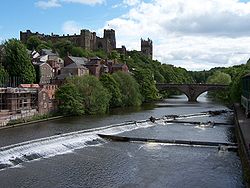
Château de Durham
Le château de Durham est un château normand datant du XIe siècle et situé à Durham dans le comté de Durham au Royaume-Uni, dans le Nord de l'Angleterre. Il est bâti sur une colline au-dessus de la rivière Wear, en face de la cathédrale de Durham.
Nearby Places View Menu

6 m
Cosin's Library
Bishop Cosin's Library, originally the Episcopal Library or Bibliotheca Episcopalis Dunelmensis, is an historic library founded in 1669 in Durham, England. Owned by the University of Durham, the library is open to the public.

35 m
Palace Green
Palace Green is an open space in the centre of Durham, England, flanked by Durham Cathedral and Durham Castle. The Cathedral and Castle together form a UNESCO World Heritage Site.
Although initially not part of the site itself, Palace Green was added to the UNESCO site in 2008.
It is situated on top of the narrow, high peninsula formed by a sharp bend in the River Wear. The cathedral is on the southern side, facing the castle across the green on the north side. To the east are Durham University buildings including the law, theology, classics and history departments, with the music department and the university's special collections library to the west.
From the north and east Palace Green is accessed by two cobbled streets called Owengate (formerly Queen's Street) and Dun Cow Lane, the latter taking its name from a local legend involving a milkmaid and her cow. From the west a passageway, 'Windy Gap', leads down to the banks of the River Wear between two buildings which are now part of the university's music department. Early in the twentieth century one of the buildings was the home of the novelist J. Meade Falkner, author of Moonfleet.
In summer, Palace Green is sometimes used by students of Durham University as a croquet lawn with the permission from the groundsman of University College Durham.
'Palace Green' is also the name of a hymn tune written by Michael Fleming (1928–2006) while a music student at the university, used for the hymn 'Sing Praise to God Who Reigns Above'.

59 m
Bishop Cosin's Hall
Bishop Cosin's Hall was a college of the University of Durham, opened in 1851 as the university's third college and named after 17th century Bishop of Durham John Cosin. It closed in 1864 due to a fall in student recruitment at the university.
It was housed in an 18th-century building on Palace Green which still carries its name.
72 m
Siege of Durham (1006)
The siege of Durham was a 1006 attack on the settlement of Durham, England, conducted by Scottish forces under Malcolm II against the English defenders, possibly as part of an attempt to gain complete control of Cumbria, or part of the traditional raiding of a new Scottish king intended to display their military might. The battle ended in defeat for the Scottish after Uhtred of Bamburgh raised an army from the lands of Bernicia and York to repel the attackers. This victory would lead to Uhtred being named Earl of Bamburgh, and later Earl of York, uniting these lands under his leadership.
Despite his defeat, Malcolm would lead another attack into England in 1018 and gained recognition that the lands north of the River Tweed were under Scottish control after the Battle of Carham.

78 m
Institute of Advanced Study (Durham)
The Institute of Advanced Study (IAS) is an interdisciplinary research centre of Durham University. The IAS – set up to mark Durham's 175th anniversary – is intended to attract scholars and public figures from across the world to collaborate on 'agenda-setting research'. It is housed in the Grade II* listed Bishop Cosin's Hall, an early 18th century building on Palace Green, Durham, within the Durham UNESCO World Heritage Site. The Institute accepted its first fellows in January 2006 and was formally inaugurated into the university in October that year.