


L'administration apostolique d'Albanie méridionale (en latin : administratio apostolica Albaniae Meridionalis ; en albanais : administratura apostolike e Shqipërisë së Jugut ; en italien : amministrazione apostolica dell'Albania meridionale) est une circonscription ecclésiastique de l'Église catholique. Érigée en 1939, elle couvre le sud de l'Albanie. Depuis 2005, elle est suffragante de l'archidiocèse métropolitain de Tirana-Durrës.
Location
1 explorer visited this place
120 m
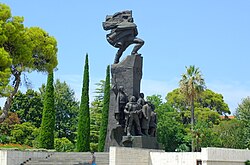
The Monument of Independence is a monument in Vlorë, Albania, dedicated to the Albanian Declaration of Independence and worked by Albanian sculptors, Muntaz Dhrami and Kristaq Rama.
It is found in the Flag's Plaza, near the building where the first Albanian government worked in 1913.
In the center of the monument is the sculpture of Ismail Kemal, the leader of the Albanian national movement and founder of Independent Albania.

208 m
The Flag's Square is the main plaza in Vlorë, Albania, dedicated to the Albanian Declaration of Independence. In its center is the Independence Monument, a sculpture by Albanian artist Mumtaz Dhrami.

227 m
The Muradie Mosque, also known as the Lead Mosque, is a mosque located in Vlorë, Albania. Situated in downtown Vlora on a central square, the mosque is surrounded by roads on all four sides, west of Sadik Zotaj, south of Lef Sallata and east of Papa Kristo Negovani streets.
The mosque was built between 1537 and 1542 CE, designed by Turkish architect Mimar Sinan in the Ottoman style, during the Ottoman Empire rule of Sultan Suleiman the Magnificent. The mosque was designated as a Cultural Monument of Albania.

624 m
Vlorë is the third most populous city of Albania and seat of Vlorë County and Vlorë Municipality. Located in southwestern Albania, Vlorë sprawls on the Bay of Vlorë and is surrounded by the foothills of the Ceraunian Mountains along the Albanian Adriatic and Ionian Sea Coasts. It experiences a Mediterranean climate, which is affected by the Ceraunian Mountains and the proximity to the Mediterranean Sea.
The coastal area of Vlorë was one of the Illyrian sites that had experienced pre-urban activity beginning from the 11th–10th centuries BC. The area was colonized by Ancient Greeks. A large fortified port-town that was inhabited from the 6th century BC to the 2nd century AD is placed, now partially submerged, in Triport, northwest of present-day Vlorë. Substantial port activity in this site occurred from at least the archaic period to the medieval period. It has been suggested that a transfer of the ancient city from the site of Triport to the site of modern Vlorë occurred. The center of the modern city features archaeological remains dating from late antiquity. Aulon, from which the modern city took its name, appears in historical sources starting from the 2nd century AD. It was conquered at different periods throughout history by Romans, Byzantines, Normans, Venetians and Ottomans.
Between the 18th and 19th centuries, the Albanians gathered both spiritual and intellectual strength for national consciousness, which conclusively led to the Albanian Renaissance. Vlorë played an instrumental role in Albanian Independence as an epicenter for the founders of modern Albania, who signed the Declaration of Independence on 28 November 1912 at the Assembly of Vlorë.
Vlorë is one of the most significant cities of southern Albania and the region of Labëria which is traditionally noted for its culture, traditions and folklore. Vlorë is served by the Port of Vlorë, the SH 8 highway, and the A2 motorway, collectively representing part of the Adriatic–Ionian Corridor and the Pan-European Corridor VIII.

738 m
Vlorë railway station is a railway station serving the city of Vlorë in southern Albania, the third most populous city of the Republic of Albania.
The station is the southern terminus of the Durrës-Vlorë railway line, and is the southernmost station on the Albanian railway network. It opened in 1985 when the railway line was extended from Nartë to Vlorë.