Grinkle railway station

Grinkle railway station was on the Whitby Redcar and Middlesbrough Union Railway. It was opened on 3 December 1883, and served the village of Easington in North Yorkshire, England. It was originally named Easington, but was renamed Grinkle on 1 April 1904 after the nearby baronial mansion of Grinkle Park, to avoid confusion with Easington station on the North Eastern Railway's Durham Coast Line. The station originally had only one platform, a second being added around 1906 to increase the passenger capacity of the line. A small goods yard with one siding was situated west of the station, serving a coal depot. There was a brick-built station building along with a signal box. The station closed on 11 September 1939, but was used as a passing loop afterwards. Though the line is closed to passengers, the track remains to service the nearby Boulby Potash Mine. However the track layout has been changed and the station has been completely dismantled.

Nearby Places View Menu
Location Image
758 m

Easington, North Yorkshire

Easington is a village in the civil parish of Loftus, in the Redcar and Cleveland district, in the ceremonial county of North Yorkshire, England and is part of the North York Moors National Park. The village is situated on the A174 road, 1 mile (1.6 km) east of Loftus, 8 miles (13 km) east of Guisborough, and 10 miles (16 km) north-west of Whitby.
Location Image
1.3 km

Street House Anglo-Saxon cemetery

The Street House Anglo-Saxon cemetery is an Anglo-Saxon burial ground, dating to the second half of the 7th century AD, that was discovered at Street House Farm near Loftus, in the unitary authority of Redcar and Cleveland, England. Monuments dating back as far as 3300 BC are located in the vicinity of the cemetery, which was discovered after aerial photography revealed the existence of an Iron Age rectangular enclosure. The excavations, carried out between 2005 and 2007, revealed over a hundred graves dating from the 7th century AD and the remains of several buildings. An array of jewellery and other artefacts was found, including the jewels once worn by a young high-status Anglo-Saxon woman who had been buried on a bed and covered by an earth mound. The woman's identity is unknown, but the artefacts and the layout of the cemetery are similar to finds in the east and south-east of England. There are contradictory indications of whether the occupants of the cemetery were Christian or pagan, as signs of both traditions are present. It perhaps represents a fusion of the two traditions during the "Conversion Period" when Christianity was taking hold among the Anglo-Saxons but pagan rituals had not yet been displaced, even among Christians. Archaeologists have suggested that the woman and at least some of the people buried around her may have migrated from the south, where bed burials were more common. They may all have been buried together within the space of a single generation, after which the cemetery was abandoned. The finds were acquired by Kirkleatham Museum, Redcar, in 2009 and have been on display there since 2011.
Location Image
1.6 km

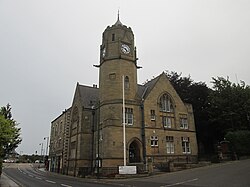
Loftus Town Hall

Loftus Town Hall is a municipal building in Water Lane in Loftus, North Yorkshire, England. The structure, which accommodates the offices and meeting place of Loftus Town Council, is a grade II listed building.
Location Image
2.1 km

Loftus, North Yorkshire

Loftus is a market town and civil parish in the Redcar and Cleveland borough of North Yorkshire, England. The town is located north of the North York Moors and sits between Whitby and Skelton-in-Cleveland. The parish includes the villages of Carlin How, Easington, Liverton, Liverton Mines and Skinningrove. It is near Brotton and Saltburn. The town was formerly known as Lofthouse.