

 English
 Français
Kerelaw House
Kerelaw House was part of the former Kerelaw Estate situated on the west coast of Ayrshire, Scotland, in the town of Stevenston.
Nearby Places View Menu
142 m
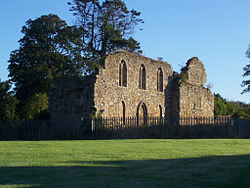
Kerelaw Castle
Kerelaw Castle is a castle ruin. It is situated on the coast of North Ayrshire, Scotland in the town of Stevenston.

502 m
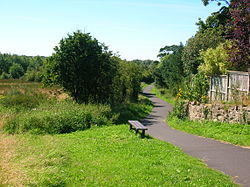
Stevenston
Stevenston (Scots: Stinstoun, Scottish Gaelic: Baile Steaphain) is a town and parish in North Ayrshire, Scotland. Along with Ardrossan and Saltcoats it is one of the "Three Towns", all of similar size, on the Firth of Clyde coast; the easternmost parts of Stevenston are about 1⁄2 mile (800 metres) from western parts of Kilwinning, the A78 trunk road runs between the settlements.
1.0 km
Piperheugh
Piperheugh, Piper's-Heugh, or even Piperhaugh was a hamlet in North Ayrshire, Parish of Stevenston, Scotland. The inhabitants were recorded as famous manufacturers of trumps, or Jew's harps. The village only survived as ruins by 1837 and no remnants are now visible, not even the plantation that bore its name. 'Pyperheugh' and 'Pypersheugh' are both recorded in the 18th century.
The site of the hamlet or village of Piperheugh is said to have been on the north-east side of Woodhead Plantation, where on the road to Guest Mailling and Ardeer Mains, once called Little Dubbs (now Ardeer Steading), was located a clump of trees known locally as the Pipers-Heugh Plantation, and extending eastwards towards the crossroads. Smith records it as being located beyond the east end of the bank upon which Ardeer House once stood.

1.5 km
Stevenston Canal
The Stevenston Canal was a waterway in North Ayrshire, Scotland, built for Robert Reid Cunningham of Seabank (now Auchenharvie) and Patrick Warner of the Ardeer Estate, which ran to the port of Saltcoats from Ardeer, and Stevenston with a number of short branches to coal pits along the length of the cut. The canal opened on 19 September 1772, the first commercial canal in Scotland. It closed in the 1830s, when it was abandoned following the exhaustion of the coal mines and the rise of importance of Ardrossan as a harbour. At the time of its construction it was said to be the "most complete water system of colliery transport ever devised in Britain."