


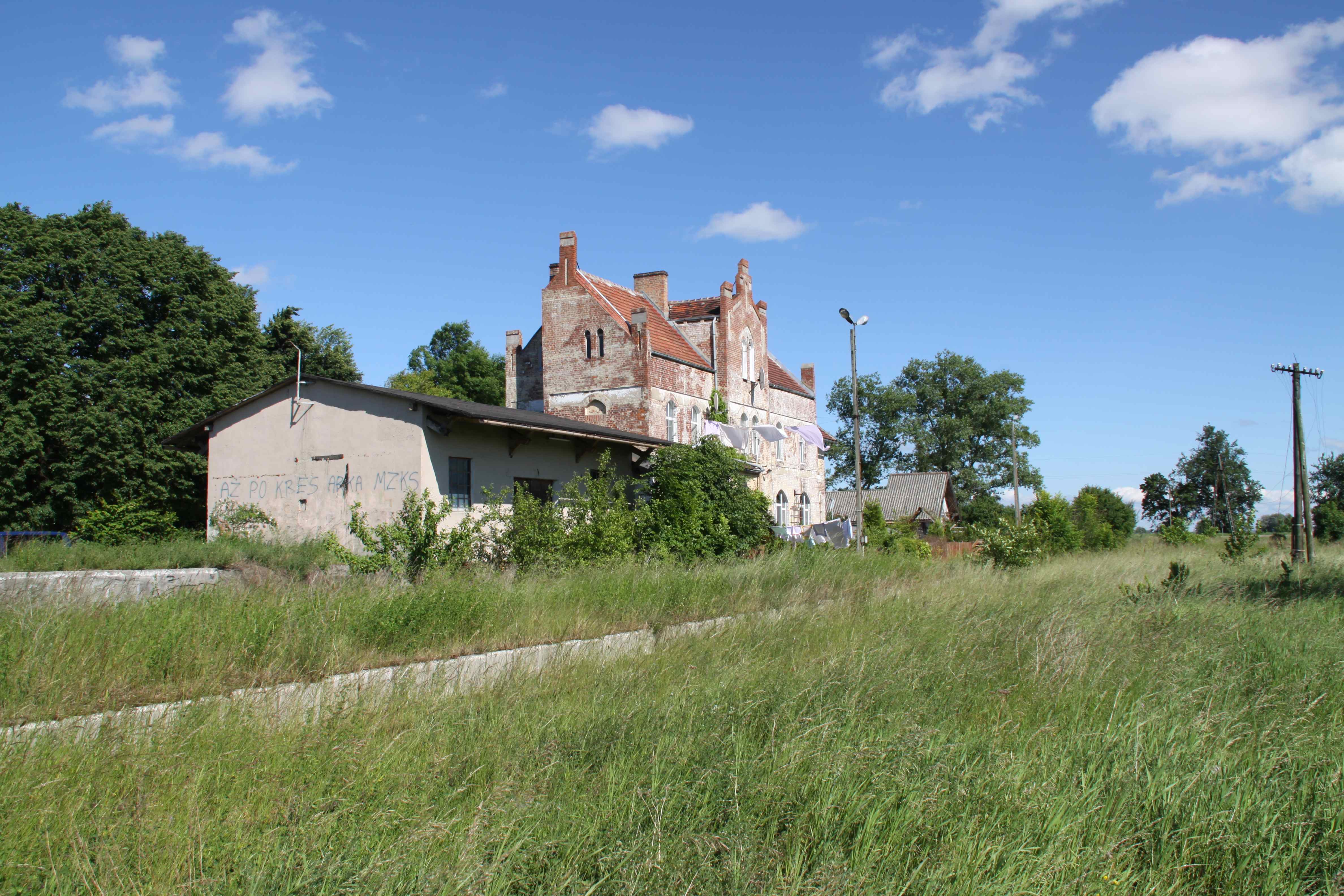
Gniew is a closed PKP railway station in Gniew (Pomeranian Voivodeship), Poland.
Location
1 explorer visited this place

526 m
Gniew is a historic town situated on the left bank of the Vistula River, in the Pomeranian Voivodeship, in northern Poland. It has 6,870 inhabitants.
It is one of the oldest towns in Eastern Pomerania, and is renowned for its medieval Brick Gothic Castle, which has become one of the region's most recognizable monuments. The town also has other medieval Gothic monuments, and in early modern times it was a centre for the wine trade and the seat of local starosts, most notably John III Sobieski, who was elected King of Poland. Gniew is located in the ethnocultural region of Kociewie in the historic region of Pomerania.

681 m
Gniew Castle is a restored castle in Gniew, in northern Poland. The original building, which served as a defensive structure for the Teutonic Order on the Vistula river, dates back to the late 13th or 14th century.
1.0 km
The Battle of Gniew or the Battle of Mewe was fought during the Polish–Swedish War, between Sweden and the Polish–Lithuanian Commonwealth from 22 September with initial skirmishes, to the main battle of October 1, 1626. Both the Swedish and Polish army were commanded by their kings – Gustavus Adolphus of Sweden and Sigismund III Vasa. The battle ended indecisively. However, Polish and Swedish armies had different objectives. Sigismund Vasa wanted to protect Gdańsk from besieging. Gustav had to protect Gniew, which was important for the prestige of his army. The battle ended in a Swedish victory.

1.0 km
Gmina Gniew is an urban-rural gmina in Tczew County, Pomeranian Voivodeship, in northern Poland. Its seat is the town of Gniew, which lies approximately 31 kilometres south of Tczew and 61 km south of the regional capital Gdańsk.
The gmina covers an area of 194.78 square kilometres, and as of 2006 its total population is 15,534.

1.0 km
Nicponia [nit͡sˈpɔɲa] is a village in the administrative district of Gmina Gniew, within Tczew County, Pomeranian Voivodeship, in northern Poland. It is located within the ethnocultural region of Kociewie in the historic region of Pomerania.