Location Image

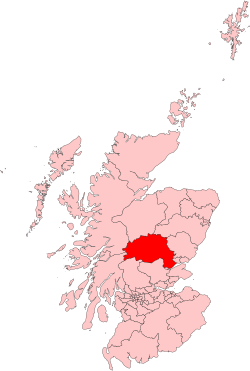
Perth and North Perthshire

Perth and North Perthshire was a county constituency of the House of Commons of the Parliament of the United Kingdom. It elected one Member of Parliament (MP) by the first past the post system of election. The constituency was created in 2005. Campaigns in the seat had resulted in a minimum of 30% of votes at each election consistently for the same two parties' choice for candidate, and the next lower-placed party's having fluctuated between 8.1% and 18.7% of the vote since its relatively recent creation. The seat attracted a record seven candidates in 2015 and had seen as few as four, in 2017. Further to the completion of the 2023 Periodic Review of Westminster constituencies, the seat was abolished. Subject to boundary changes – entailing the transfer of "North Perthshire" to the new constituency of Angus and Perthshire Glens, offset by the addition of Strathearn, Almond and Earn and Kinross-shire from the abolished constituency of Ochil and South Perthshire – it was reformed as Perth and Kinross-shire, first contested at the 2024 general election.

Nearby Places View Menu
Location Image
0 m

Diocese of St Andrews, Dunkeld and Dunblane

The Diocese of St Andrews, Dunkeld and Dunblane is one of the seven dioceses of the Scottish Episcopal Church, part of the Anglican Communion. It is centred on St Ninian's Cathedral in Perth, and covers Fife, Perthshire, Kinross-shire, Clackmannanshire, and eastern and central Stirlingshire (western Stirlingshire is in the Diocese of Glasgow and Galloway). The current Bishop of St Andrews, Dunkeld and Dunblane is Ian Paton. The diocese continues the titles of three ancient Scottish dioceses. The Diocese of St Andrews was founded in 906 and was raised to an archdiocese in 1472. Throughout the Scottish Reformation the diocese continued under the auspices of moderate, Episcopalian reformers. From 1704 until 1726, the archbishopric was vacant, until it was recreated as the Diocese of Fife. In 1842, the diocese, no longer an archdiocese, was moved back to St Andrews and united with the Diocese of Dunkeld and Dunblane. The Diocese of Dunkeld is thought to have begun in the 9th century, but the first reliable date is that of the consecration of Cormac as bishop in 1114. The line of bishops continued with only a few vacancies until, in 1842, the diocese was united with St Andrews. In 1878, the Roman Catholic Church revived the Diocese of Dunkeld as part of its structures in Scotland. The Diocese of Dunblane was founded in 1162. Its line of bishops continued with a few vacancies until it was united with the Diocese of Dunkeld in 1776.
Location Image
0 m

Perth Charterhouse

Perth Charterhouse or Perth Priory, known in Latin as Domus Vallis Virtutis ("House of the Valley of Virtue"), was a monastic house of Carthusian monks based at Perth, Scotland. It was the only Carthusian house ever to be established in the Kingdom of Scotland, and one of the last non-mendicant houses to be founded in the kingdom. The traditional founding date of the house is 1429. Formal suppression of the house came in 1569, though this was not actualised until 1602. King James VI Hospital now occupies the Priory's former location.
Location Image
25 m

King James VI Hospital

King James VI Hospital is an historic building in Perth, Scotland. Located on Hospital Street, it is a Category A listed building, built in 1750. It stands on the former site of Perth Priory (1429), which was burned in 1559 during the Reformation. Of the Priory buildings, said to be "of wondrous cost and greatness," nothing survives above ground. Excavations have failed to identify the exact location. The name Pomarium Street, for modern housing near the site of the medieval buildings, recalls the site of the house's orchard, which seems to have survived into the 18th century. An H-shaped building, four storeys high, it is finished in greywash harled rubble "with raised ashlar margins and quoins at angles". The central block is topped by an octagonal belfry believed to have been taken from Nairne House, in Bankfoot, which was demolished in 1748 after being forfeited during the 1745 Jacobite Rebellion. The building was funded by royal endowment and public subscription, and it served several functions, including being an almshouse, an industrial school and an infirmary, as well as being a reformatory for delinquents. The building was shaped in an "H" to maximise the supervision of its occupants by a minimal amount of staff. In 1814, most of the building was rented out for other uses, and in 1838, a separate infirmary was built 500 feet to the west, on York Place (now occupied by A. K. Bell Library). The building was renovated and restored in 1976 and has 21 residential flats within its modified interior. The hospital boardroom was maintained.
Location Image
60 m

New County Hotel fire

On 2 January 2023, a fire broke out at New County Hotel in Perth, Scotland. It killed three people and one dog, and injured eleven other people.