


Beta Theta Pi Fraternity House, also known as the Eta chapter of Beta Theta Pi, is a historic fraternity house located at Chapel Hill, Orange County, North Carolina. The fraternity house was listed on the National Register of Historic Places on April 20, 2005.
Location
1 explorer visited this place
56 m
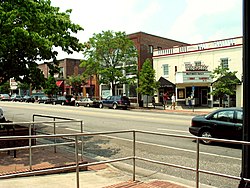
Franklin Street is a prominent thoroughfare in Chapel Hill, North Carolina. Historic Franklin Street is considered the center of social life for the University of North Carolina at Chapel Hill, as well as the town of Chapel Hill.
It is home to numerous coffee shops, restaurants, museums, bookshops, music stores and bars. The street in downtown Chapel Hill is notable for its nightlife, culture, and regular festivities. The stretch of college-oriented businesses continues west into neighboring Carrboro, where the street's name changes to Main Street. Both streets are home to small music venues, like the Cat's Cradle and the Carrboro Arts Center, which were influential in the birth of Chapel Hill rock. UNC's Morehead Planetarium and Science Center, as well as the Ackland Art Museum, are also located in this area.

76 m
Top of the Hill is a brewpub, restaurant, event space and distillery located in downtown Chapel Hill, North Carolina. The restaurant and brewery opened in 1994 at the intersection of Franklin and Columbia Streets adjacent to the University of North Carolina at Chapel Hill. It was one of the first microbreweries in the state. TOPO expanded in 2010, adding the Great Room event space and the Back Bar, which is home to North Carolina's first on-premise cask ale program.
TOPO Distillery opened in 2012 and produces the only 100% locally sourced and USDA certified organic spirits in the deep South: TOPO Organic Vodka, TOPO Organic Piedmont Gin and TOPO Moonshine Carolina Whiskey. All three organic spirits are made with 100% organic Carolina soft red winter wheat grown less than 100 miles from the distillery. The distillery is also located on Franklin Street, three blocks south in the former printing press room of the Chapel Hill News.

84 m
Halloween on Franklin Street is a yearly tradition in Chapel Hill, North Carolina, that encompasses a massive gathering on Franklin Street, the cultural hub of the town. The Halloween celebration began in the early 1980s as a considerably smaller event, involving Chapel Hill residents and college students from The University of North Carolina. Attendees of the event dress up in creative Halloween costumes and walk up and down Franklin Street celebrating the holiday. Since its beginnings, the event had grown in size every year until 2008. Although not sponsored by the Town of Chapel Hill, the celebration has become an attraction for visitors from across the South. Between 2004 and 2007, it was estimated that about 80,000 people converged on Franklin Street for the event, while Chapel Hill is estimated to have a population of 54,492 as listed in the 2007 census, evidence of the number of people who make the trip to Chapel Hill to attend. Because of the size of the celebration, the Town of Chapel Hill closes Franklin Street to all vehicular traffic and prohibits parking anywhere near downtown. Along with the big crowds come safety issues, with some of the biggest concerns being alcohol poisoning and gang-related violence. To deal with these issues, hundreds of police officers patrol the downtown area throughout the entire night. In 2007, approximately 400 police officers were deployed to Franklin Street to ensure that nothing got out of hand. In 2008, the Town of Chapel Hill implemented new measures to attempt to cut down on the size of the Halloween celebration in an action dubbed "Homegrown Halloween" to reduce the crowd size and discourage people from out of town from coming to Chapel Hill. The shuttle service that had formerly transported people from park and ride lots to Franklin Street was shut down and the results of Chapel Hill's efforts showed when about 35,000 people showed up for the event.
Among the alternatives to the traditional Franklin Street celebration are the Halloween-themed planetarium shows at Morehead Planetarium and Science Center [7], which include two versions of "Scare-o-lina Skies", one for families with school-age children and one for adults and older teens. The planetarium closes by mid-afternoon on Halloween because the adjacent parking lot becomes a staging area for public safety vehicles serving the Franklin Street nighttime celebration.

139 m
Chapel Hill Town Hall is a historic town hall located at Chapel Hill, Orange County, North Carolina. It built in 1938, and is a two-story, red brick, Colonial Revival style building. It has a full basement and a hipped slate roof topped by an octagonal wooden cupola.
It was listed on the National Register of Historic Places in 1990.

303 m
The Confederate Monument, University of North Carolina, commonly known as Silent Sam, is a bronze statue of a Confederate soldier by Canadian sculptor John A. Wilson, which stood on McCorkle Place of the University of North Carolina at Chapel Hill from 1913 until it was pulled down by protestors on August 20, 2018. Its former location has been described as "the front door" of the university and "a position of honor".
Establishing a Confederate monument at a Southern university became a goal of the North Carolina chapter of the United Daughters of the Confederacy in 1907. UNC approved the group's request in 1908 and, with funding from UNC alumni, the UDC and the university, Wilson designed the statue, using a young Boston man as his model. At the unveiling on June 2, 1913, local industrialist and UNC trustee Julian Carr gave a speech espousing white supremacy, while Governor Locke Craig, UNC President Francis Venable and members of the UDC praised the sacrifices made by students who had volunteered to fight for the Confederacy. The program for the unveiling simply referred to the statue as "the Confederate Monument", with the name "Soldiers Monument" also being used around the same time. The name Silent Sam is first recorded in 1954, in the student newspaper The Daily Tar Heel.
Beginning in the 1960s, the statue faced opposition on the grounds of its racist message, and it was vandalized several times during the civil rights movement. Protests and calls to remove the monument reached a higher profile in the 2010s, and in 2018, UNC Chancellor Carol L. Folt described the monument as detrimental to the university, and said that she would have the statue removed if not prohibited by state law. Increased protests and vandalism resulted in the university spending $390,000 on security and cleaning for the statue in the 2017–18 academic year. On the day before fall classes started in August 2018, the statue was toppled by protesters, and later that night removed to a secure location by university authorities. A statement from Chancellor Folt said the statue's original location was "a cause for division and a threat to public safety," and that she was seeking input on a plan for a "safe, legal and alternative" new location.
UNC-Chapel Hill's board of trustees recommended in December 2018 that the statue be installed in a new "University History and Education Center" to be built on campus, at an estimated cost of $5.3 million, but this was rejected by the University of North Carolina Board of Governors. The pedestal base and inscription plaques were removed in January 2019, with a statement from Chancellor Folt citing public safety.
In November 2019 UNC donated the statue to the Sons of Confederate Veterans with a $2.5 million trust for its "care and preservation", on the condition that the statue would not be displayed in the same county as any UNC school. The agreement to donate the statue was made before the lawsuit was filed, and the lawsuit itself was overturned by the judge who originally approved it, who ruled that the SCV lacked standing to bring the lawsuit.
Book your tour near
Beta Theta Pi Fraternity House
Book Now
4.2
in partnership with
GetYourGuide.com