


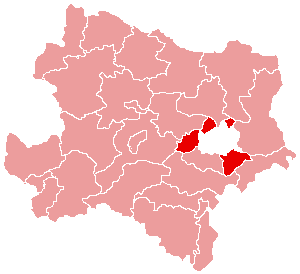
Le district de Wien-Umgebung est une ancienne subdivision territoriale du Land de Basse-Autriche en Autriche. Le district existait depuis 1954. En 2017, ses municipalités ont été réparties dans les quatre districts adjacents.
Gallery


Sponsored
Location
0 m
Bezirk Wien-Umgebung was a district of the state of Lower Austria in Austria. The district comprised four non-contiguous districts on the outer fringes of Vienna: Klosterneuburg and Gerasdorf to the north of the city, Schwechat to its south-east and Purkersdorf on Vienna's western side.
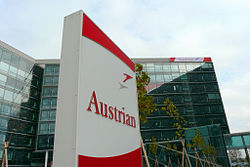
Vienna International Airport, the headquarters of Austrian Airlines, and the headquarters of Niki are in the city of Schwechat, in the district.
The district existed from 1954 to 2016. In 2017 the municipalities became part of four adjacent districts.
463 m
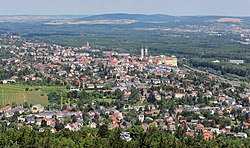
Klosterneuburg is a town in the Tulln District of the Austrian state of Lower Austria. Frequently abbreviated to Kloburg by locals, it has a population of about 27,500. The Stift Klosterneuburg, which was established in 1114 and soon after given to the Augustinians, is of particular historical importance.

1.1 km
Klosterneuburg Abbey is a twelfth-century Augustinian monastery of the Catholic Church located in the town of Klosterneuburg in Lower Austria. Overlooking the Danube, just north of the present Vienna city limits at the Leopoldsberg, the monastery was founded in 1114 by Saint Leopold III of Babenberg, the patron saint of Austria, and his second wife Agnes of Germany.
The abbey church, dedicated the Nativity of Mary, was consecrated in 1136 and remodeled in the Baroque style in the seventeenth century. The impressive monastery complex was mostly constructed between 1730 and 1834. Its foundations, including a castle tower and a Gothic chapel, date back to the twelfth century. Other older buildings still extant within the complex include the chapel of 1318 with Saint Leopold's tomb. From 1634 on, the Habsburg rulers had the facilities rebuilt in the Baroque style, continued by the architects Jakob Prandtauer and Donato Felice d'Allio. The plans to embellish the monastery on the scale of an Austrian Escorial were later resumed by the Neoclassical architect Joseph Kornhäusel, though only small parts were actually carried out. In 1879, the abbey church and monastery were restored according to plans by Friedrich von Schmidt, and the neo-Gothic twin steeples were erected.
Klosterneuburg Monastery contains the Verduner Altar, made in 1181 by Nicholas of Verdun. Its three parts comprise 45 gilded copper plates modeled on Byzantine paragons, similar to the Shrine of the Three Kings at Cologne Cathedral. The monastery also contains a museum with a collection of Gothic and Baroque sculptures and a gallery of paintings, including fifteen-panel paintings by Rueland Frueauf from 1505, four Passion paintings from the backside of the Verduner Altar from 1331, and the Babenberg genealogical tree.

1.3 km
The Konrad Lorenz Institute for Evolution and Cognition Research is an international center for advanced studies in the life and sustainability sciences. It is a "Home to Theory that Matters" that supports the articulation, analysis, and integration of theories in biology and the sustainability sciences, exploring their wider scientific, cultural, and social significance. The institute is located in Klosterneuburg, near Vienna, Austria. Until 2013, the institute was located in the family mansion of the Nobel Laureate Konrad Lorenz in Altenberg. Lorenz' work laid the foundation for an evolutionary approach to mind and cognition.
The institute unites fellows, visiting scholars, students, and external faculty. Through a lecture and seminar series, the KLI also offers a platform for the critical public discussion of current themes in the biosciences.
Founded in 1990 by Rupert Riedl, followed by Gerd B. Müller and Philipp Mitteröcker as presidents of the institute, the KLI is funded by a private trust and receives additional support from the Province of Lower Austria. The institute has close ties with many of the higher education institutions in Vienna and Lower Austria, as well as with a number of international institutions with similar aims.

2.2 km