


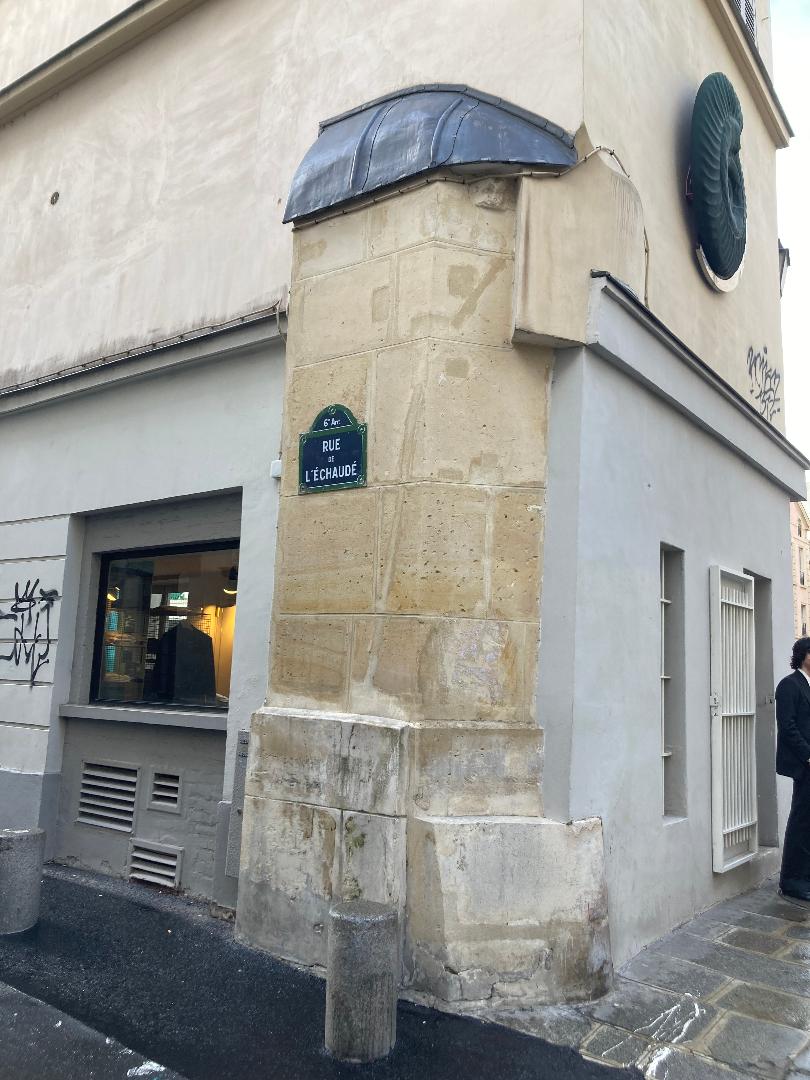
La rue de l'Échaudé est une voie située dans le quartier Saint-Germain-des-Prés du 6e arrondissement de Paris en France.
Gallery




Sponsored
Location
1 explorer visited this place

399 m
The Place Saint-Sulpice is a large public square, dominated on its eastern side by the Church of Saint-Sulpice. It was built in 1754 as a tranquil garden in the Latin Quarter of the 6th arrondissement of Paris.
399 m
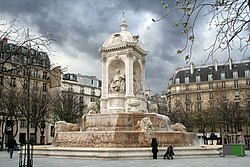
The Fontaine Saint-Sulpice is a monumental fountain located in Place Saint-Sulpice in the 6th arrondissement of Paris. It was constructed between 1843 and 1848 by the architect Louis Visconti, who also designed the tomb of Napoleon.
The four figures on the fountain represent four French religious figures of the 17th century famous for their eloquence.
Bossuet, North, statue by Jean-Jacques Feuchère
Fénelon, East, statue by François Lanno
Fléchier, West, statue by Louis Desprez
Massillon, South, statue by Jacques-Auguste Fauginet, completed by Fouquiet after the death of Fauginet.
In French the fountain is also called "La Fontaine des quatre points cardinaux", a pun which means the "Fountain of the four points of the compass" or, in the form "La Fontaine des quatre point cardinaux", which is pronounced in the same way) "Fountain of the four not cardinals". This name is also a pun, because "points cardinaux" in French is a play on words. The four bishops portrayed in the statues, while renowned, were never elevated to the rank of cardinal.

429 m
Mundolingua is a museum situated in the 6th arrondissement of Paris. Its purpose is to present information, objects and documents relating to language, linguistic diversity and linguistics to the general public.

470 m
The 6th arrondissement of Paris is one of the 20 arrondissements of the capital city of France. In spoken French, it is referred to as le sixième.
The arrondissement, called Luxembourg in a reference to the seat of the Senate and its garden, is situated on the Rive Gauche of the River Seine. It includes educational institutions such as the École nationale supérieure des Beaux-Arts, the École des hautes études en sciences sociales and the Institut de France, as well as Parisian monuments such as the Odéon-Théâtre de l'Europe, the Pont des Arts, which links the 1st and 6th arrondissements over the Seine, Saint-Germain Abbey and Saint-Sulpice Church.
This central arrondissement, which includes the historic districts of Saint-Germain-des-Prés and Luxembourg, has played a major role throughout Parisian history. It is well known for its café culture and the revolutionary existentialism intellectualism of the authors that lived there, including Jean-Paul Sartre, Simone de Beauvoir, Gertrude Stein, Paul Éluard, Boris Vian, Albert Camus and Françoise Sagan.
With its cityscape, intellectual tradition, history, architecture and central location, the arrondissement has long been home to French intelligentsia. It is a major locale for art galleries and fashion stores and is one of Paris's most expensive areas and one of France's richest districts in terms of average income. It is part of what is called Paris Ouest alongside the 7th, 8th and 16th arrondissements, as well as the Neuilly-sur-Seine inner suburb.

485 m
The Théâtre du Vieux-Colombier is a theatre located at 21, rue du Vieux-Colombier, in the 6th arrondissement of Paris. It was founded in 1913 by the theatre producer and playwright Jacques Copeau. Today it is one of the three theatres in Paris used by the Comédie-Française.
In May 1944 it saw the première of Jean-Paul Sartre's existentialist drama Huis Clos.
Book your tour near
Rue de l'Échaudé
→