


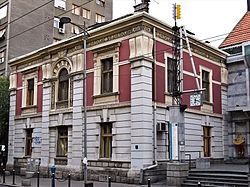
L'Immeuble de Ljubomir Miladinović (en serbe cyrillique : Зграда Љубомира Миладиновића ; en serbe latin : Zgrada Ljubomira Miladinovića) est situé à Belgrade, la capitale de la Serbie, dans la municipalité urbaine de Stari grad. Construit en 1938, il est inscrit sur la liste des biens culturels de la Ville de Belgrade.
Gallery


Sponsored
Location
138 m
The house of Jevrem Grujić is located in 17 Svetogorska Street, – the first designated heritage building since the founding of the Cultural Heritage Protection Institute of the City of Belgrade, in 1961. It is located in the immediate distance from the theatre "Atelje 212". The descendants of Jevrem Grujić, a prominent figure of the Serbian 19th century diplomacy, still live in this house. The life and work of members and descendants of the Grujić family is associated with the important political and social events in Serbia.

158 m
Atelje 212 is a theatre located in Belgrade, Serbia.
Established in 1956 on the premises of the Borba building in front of 212 chairs, its opening play was the staging of Johann Wolfgang von Goethe's Faust directed by Mira Trailović.
207 m
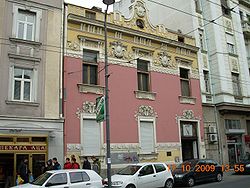
Uroš Predić Studio is located at 27 Svetogorska Street in Belgrade, the capital of Serbia. It was built in 1908 for a merchant Josif Predić. His brother Uroš Predić, one of the most important Serbian Realist painters, moved in the house in 1909 and used it as his studio until his death in 1953.
Due to its specific small pink façade in the Vienna Secession style, it has been described as a bonbonniere. As of 2018, it is the oldest preserved atelier in Belgrade. It has been declared a cultural monument and protected by law in 1987.

217 m
Jovan Cvijić House is situated in Belgrade, in 5 Jelena Ćetković Street. The house was built in 1905, on the site of the former garden of Мitropolit Mihailo of Belgrade, which in 1907 was transformed into the square. A couple of years later, more precisely in 1924, the square was named Коpitareva gradina after the famous Slavist and linguist, Јеrnej Kopitar. Many important figures of that time used to build their houses in this area: a sculptor Petar Palaviccini, a doctor and a writer Laza Lazarević, an architect Milan Antonović.

219 m
The Allied bombing of Yugoslavia in World War II involved air attacks on cities and towns in the Kingdom of Yugoslavia by the United States Army Air Force and Royal Air Force, including the Balkan Air Force, between 1941 and 1945, during which period the entire country was occupied by the Axis powers. Dozens of Yugoslav cities and towns were bombed, many repeatedly. These attacks included intensive air support for Yugoslav Partisan operations in May–June 1944, and a bombing campaign against transport infrastructure in September 1944 as the German Wehrmacht withdrew from Greece and Yugoslavia. This latter operation was known as Operation Ratweek. Some of the attacks caused significant civilian casualties.