

 English
 Français
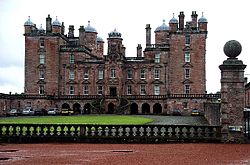
Château de Drumlanrig
Le château de Drumlanrig est un château écossais situé dans le district de Dumfries and Galloway et classé dans la liste des monuments historiques du Royaume-Uni. Il est la propriété du duc de Buccleuch. Le bâtiment, construit entre 1679 et 1689 en grès rose, est typique de l'architecture Renaissance de la fin du XVIIe siècle. Il a été édifié à l'emplacement d'une ancienne forteresse appartenant aux Douglas et surplombant Nith Valley. Le château actuel dispose de 120 pièces, 17 tourelles et quatre tours. Il abrite une des deux versions originales du tableau La Madone aux fuseaux peint par Léonard de Vinci et son atelier, volé en 2003, mais retrouvé et restitué en 2007.
Nearby Places View Menu

2.3 km
Carron Water, Dumfriesshire
The Carron Water (Scottish Gaelic: Carrann) is a tributary of the River Nith in southwest Scotland. It rises in the Dalveen Pass in the Lowther Hills as its headwater streams, the Dinabid Linn, Dalveen Lane and Lavern Burn join to flow southwards, to the west of the village of Durisdeer, to meet the Nith at Carronbridge.

2.3 km
Carronbridge
Carronbridge is a village in the parish of Morton in Dumfries and Galloway, Scotland. The village is at the junction of the A76 and A702 roads approximately 1 mile (2 km) north of Thornhill. The hamlet of Enterkinfoot lies slightly to the north. To the west of the village the Carron Water flows into the River Nith. Carronbridge Sawmill is in the village and is a Category B listed building built in the 1850s for the Duke of Buccleuch's Drumlanrig estate.
Carronbridge station on the 'Nith Valley' line was located near the hamlet of Enoch and is also the site of the Carronbridge railway viaduct. The line remains open to passenger and freight traffic. A resident is David Vernon, known for his long-distance running and appearance on the Channel 4 show 'Countdown'.
South of the village are the remains of a Roman temporary camp. Adjacent to it is an indigenous farming enclosure, which appears to have been occupied in the Roman period. This is an interesting, possibly unique, example of a Roman fort co-existing with a native settlement.

4.1 km
Nith Bridge cross
The Nith Bridge cross (also known as the Boatford cross) is a sculptured Anglo-Saxon cross, near the village of Thornhill, Dumfries and Galloway. It is the best preserved monument of its type in the region, after the Ruthwell Cross, although the arms are missing. It is a Scheduled monument. The cross is made of red sandstone and carved with animal and plant interlace designs in low relief. It is 6 feet 6 inches tall.

4.5 km
Scaur Water
Scaur Water is a river which rises near Polskeoch in the Scaur hills in the region of Dumfries and Galloway, Scotland.
It flows from its source near Sanquhar in the Southern Uplands and joins the River Nith two miles southwest of Thornhill. The total length is 30 km (19 mi). During its course it descends from 500m to 55m altitude, and forms part of the boundary between Tynron and Keir Parishes.
The river valley, the Scaur Glen, displays several sculptures by Andy Goldsworthy and Bronze Age forts, and is lined for much of its length with birch and oak forest.
The river is renowned for trout fishing and canoeing, especially at the Glenmarlin Falls near Penpont. A local legend tells of the ghosts of a horse and rider who drowned in a deep pool, known colloquially as the Black Hole, at the bottom of the falls.

4.7 km
Thornhill railway station (Scotland)
Thornhill is a closed station. It served the country town of Thornhill in Dumfries and Galloway. The station site is a mile or so from the town. Four miles north of Thornhill is Drumlanrig Castle, home to the Duke of Buccleuch and Queensberry. The Glasgow and South Western main line rail route between Kilmarnock and Dumfries is forced to make a long detour to the east of Thornhill and through a long tunnel, rather than the more logical route nearer Thornhill town centre and up the Nith Valley, so as not to be seen from the Buccleuch estate. The distance of the station from Thornhill may be one reason that passenger use was light and stopping services ended in 1965. There was formerly a busy livestock market near to the station, which eventually closed around 2001.
In 2014, Dumfries and Galloway Council proposed creating a funding application to reopen the station.