

 English
 Français

St Bartholomew's Church, Armley
St Bartholomew's Church, Armley is a parish church in the Church of England in Armley, West Yorkshire. The church is one of two Church of England churches in Armley; the other being Christ Church. Worship at St Bartholomew's is firmly rooted in the Anglo-Catholic tradition of the Church of England with a solemn mass being celebrated weekly.
Nearby Places View Menu

387 m
Armley
Armley is a district in the west of Leeds, West Yorkshire, England. It starts less than 1 mile (1.6 km) from Leeds city centre. Like much of Leeds, Armley grew in the Industrial Revolution and had several mills, one of which now houses the Leeds Industrial Museum at Armley Mills. Armley is predominantly and historically a largely working class area of the city, still retains many smaller industrial businesses, and has many rows of back-to-back terraced houses.
It sits in the Armley ward of Leeds City Council and Leeds West and Pudsey parliamentary constituency.
In 2022, statistics released by West Yorkshire Police revealed Armley and New Wortley had the second highest crime rate in Leeds after Leeds city centre.

579 m
Armley Moor railway station
Armley Moor railway station was a station on the former Great Northern Railway between Leeds and Bramley. The location was between Carr Crofts and Wortley Road bridges, accessed via Station Road.
It served the Leeds suburb of Armley in West Yorkshire, England until closure in July 1966 due to the Beeching Axe. The station was immortalised in 1964 in the song "Slow Train" by Flanders and Swann.

615 m
Armley asbestos disaster
The Armley asbestos disaster is a public health problem originating in Armley, a suburb of Leeds, West Yorkshire, England. Described by Dr. Geoffrey Tweedale as a "social disaster", it involved the contamination with asbestos dust of an area consisting of around 1,000 houses in the Armley Lodge area of the city.
The contamination was the result of the activities of a local asbestos factory, part of the Turner & Newall (T&N) group (often referred to by the name of its founders, J. W. Roberts Ltd.) and occurred between the end of the 19th century and 1959 when the factory eventually closed. At its peak the factory had 250 employees. At least 300 former employees are believed to have died from asbestos-related illnesses, and a number of cancer deaths in the Armley area were traced to the factory in 1988 as a result of an investigation by the Yorkshire Evening Post. The estate was found to have the highest incidence in the country of mesothelioma. As the interval between exposure and diagnosis can be up to 50 years the number of further deaths which may occur due to the factory's emissions or residual dust since its closure cannot be predicted.
723 m
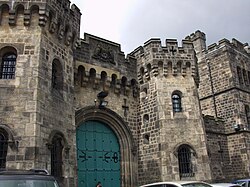
HM Prison Leeds
HM Prison Leeds is a Category B men's prison, located at Gloucester Terrace in the Armley area of Leeds in West Yorkshire, England, which opened in 1847. Leeds Prison is operated by His Majesty's Prison Service, and is still known locally as Armley Gaol, the historical name of the prison.