Ellingstring is a village and civil parish in Wensleydale in North Yorkshire, England, about 5 miles (8 km) south-east of Leyburn, and 3.5 miles (5.6 km) north of Masham. Historically it was in the wapentake of Hang East. From 1974 to 2023 it was part of the Borough of Harrogate, it is now administered by the unitary North Yorkshire Council. The population of the parish was estimated at 80 in 2012. The parish now shares a grouped parish council, known as Fearby, Healey and District Parish Council, with Colsterdale, Fearby, Healey and Ilton cum Pott. It falls within the Skipton and Ripon constituency for the UK Parliament. The name of the village was first recorded in 1198 as Elingstrengge, and derives from the Old English Ella and the Old Norse strengr, meaning watercourse.

Nearby Places View Menu
Location Image
1.9 km

High Ellington

High Ellington is a village in lower Wensleydale in North Yorkshire, England, about 2.5 miles (4 km) north-west of Masham. The smaller village of Low Ellington is 0.6 miles (0.97 km) to the east. High Ellington is the largest settlement in the civil parish of Ellington High and Low, which also includes Low Ellington and the scattered settlement of Sutton (which includes High Sutton, Low Sutton, Sutton Penn and Sutton Grange). The population of the parish was estimated at 60 in 2013. High Ellington was historically, with Low Ellington, a township in the ancient parish of Masham in the North Riding of Yorkshire. At the time of the Domesday Book it was in the possession of Count Alan of Brittany. It became a civil parish in 1866, then known as Ellingtons. In 1886 Sutton was transferred to the parish from Healey with Sutton. From 1974 to 2023 it was part of the Borough of Harrogate, it is now administered by the unitary North Yorkshire Council. The parish now shares a grouped parish council, known as Masham Parish Council, with Masham, Burton on Yore and Swinton with Warthermarske.
Location Image
2.5 km

Low Ellington

Low Ellington is a small village in lower Wensleydale in North Yorkshire, England about 2 miles (3.2 km) north-west of Masham. It is 0.5 miles (0.8 km) east of the much larger village of High Ellington. The village was historically also known as Nether Ellington. Low or Nether Ellington formed, with High or Over Ellington, a township in the ancient parish of Masham in the North Riding of Yorkshire. From 1974 to 2023 it was part of the Borough of Harrogate, it is now administered by the unitary North Yorkshire Council. At the time of the Domesday Book it was in the possession of Count Alan of Brittany. In 1566 Christopher Danby acquired the manor of Nether Ellington from Henry Lord Scrope, and the manor remained in the Danby family until 1883.
Location Image
2.6 km

Jervaulx Abbey

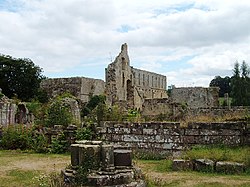
Jervaulx Abbey in East Witton in North Yorkshire, 14 mi (23 km) north-west of the city of Ripon, was one of the great Cistercian abbeys of Yorkshire, England, dedicated to St Mary in 1156. It is a Grade I listed building. The place name Jervaulx is first attested in 1145, where it appears as Jorvalle. The name is French for 'the Ure valley' and is perhaps a translation of the English 'Ure-dale', also known as Yoredale. The valley is now called Wensleydale.
Location Image
2.6 km

St Paul's Church, Healey

St Paul's Church is the parish church of Healey, North Yorkshire, a village in England. The church was designed by E. B. Lamb in Decorated style, and was completed in 1848. A local legend claims that funding for the construction came from the winnings of the local horse Ellington, but this is impossible as Ellington only raced in 1855 and 1856. The church was grade II* listed in 1966. The church is built of stone with Welsh slate roofs. It consists of a nave, a south porch, north and south transepts, a chancel, and a steeple at the crossing. The steeple has a tower with angle buttresses, two-light bell openings, a cornice, and a broach spire with four lucarnes. The transepts are short and flat-roofed with parapets, and each contains an oculus window. Inside, the crossing is of unusual construction, with four narrow arches, with heavy squinches in the corners supporting the tower. It is described by Nikolaus Pevsner as "the real Lamb Grand Slam". The stone altar rail with iron gates, wooden pews and choir stalls, pulpit and font are all designed by Lamb, as are the north and west stained glass windows. The east window was designed by Robert Frankland-Russell.