


Église Saint-Pierre de Tibériade
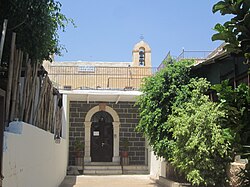
L'église Saint-Pierre de Tibériade (en hébreu : כנסיית פטרוס הקדוש ; en latin : Ecclesia Sancti Petri) est un lieu de culte catholique situé près d'un monastère à Tibériade, sur la côte ouest de la mer de Galilée, dans le district nord d'Israël. Elle est dédiée à saint Pierre, un des apôtres de Jésus, car elle se trouve près du lieu ou Pierre aurait eu pour habitude de pêcher.
Gallery


Sponsored
Location
88 m
The St. Peter's Church is a religious building belonging to the Catholic Church which is next to a monastery in Tiberias, a town on the western shore of the Sea of Galilee, in the Lower Galilee, in northern District of Israel. The church is named after St. Peter one of the apostles of Jesus, because it is near where Catholics believe that St. Peter was a fisherman in Galilee.
The church was founded in the early twelfth century by the Crusaders. With the conquest of Tiberias by Muslims after the defeat of Christians in the Battle of Hattin in 1187 it became a mosque.
During the eighteenth century, the interest of the members of the Franciscan order in the church resulted in occasional visits, first at the feast of St. Peter, and eventually services were permanent renewed. During this century the Franciscans retook control of the church.
In 1833 a replica of the statue of St. Peter by Arnolfo di Cambio in the Vatican was brought, and in 1847 a monastery was established near the church.
In 1870 the current facade of the temple was built. After World War II a memorial wall was built depicting various issues related to the Catholic Church in Poland and a central image of the Black Madonna of Czestochowa.

134 m
The Scots Hotel is a hotel in Tiberias, Israel, formerly the Scots Mission Hospital, also known as the Scottish Compound. The hotel is run by the Church of Scotland.

313 m
According to Jewish tradition, the Tomb of Maimonides is located in Tiberias, Israel. Although Maimonides, a Sephardic Jew, died in Fustat, Egypt, on 12 December 1204, it is believed that he was only briefly buried in Fustat before being reinterred in Tiberias. Owing to his recognition as a prominent Jewish philosopher, his tomb is one of Israel's most important Jewish pilgrimage sites and is also among Tiberias' most visited tourist attractions. The site also serves as the burial place of Yohanan ben Zakkai, a prominent Tanna of the Second Temple period; and Isaiah Horowitz, a prominent Jewish mystic of the 16th/17th century.

508 m
The Maimonides Heritage Center is an educational and cultural non-profit organization in the Israeli city of Tiberias. Established in 2003 by Rabbi Yamin Levy, it works to disseminate the teachings and worldview of Maimonides to the general public. The main attraction is the Setton Family Hospitality Center, a small museum and study hall.

1.1 km
Bethmaus, or Beth Maʿon, also called Maon, was a Jewish village during the Late Second Temple and Mishnaic periods, tentatively identified with the site of Nasir ad-Din by Guérin and with Tell Maʿūn slightly west of it by Kitchener. Ishtori Haparchi had situated it in 1322 upon the hill directly north-west of the city of Tiberias, at a distance of one biblical mile, rising to an elevation of 250 metres above sea-level. It is now incorporated within the modern city bounds of Upper Tiberias. The remaining historical structure at the site is a sheikh's tomb.
Some modern researchers place the ancient Bethmaus at the site of the ruined Arab village of Khirbet Nadhr ad-Din or Kh. Naṣr ad-Din, saying that with the passing of time, the old namesake was transferred to Tell Maʿūn, a short distance away.
The Midrash says of the village, "Beth Maʿon, they ascend to it from Tiberias, but they go down to it from Kefar Shobtai." The Jerusalem Talmud, citing a variant account, says that they would go down to Beth Maʿon from its broad place.
Book your tour near
Église Saint-Pierre de Tibériade
→