

 English
 Français
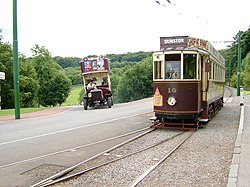
Beamish Museum transport collection
Beamish Museum contains much of transport interest, and the size of its site makes good internal transportation for visitors and staff purposes a necessity.
Nearby Places View Menu

0 m
Beamish Museum
Beamish Museum is the first regional open-air museum, in England, located at Beamish, near the town of Stanley, in County Durham, England. Beamish pioneered the concept of a living museum. By displaying duplicates or replaceable items, it was also an early example of the now commonplace practice of museums allowing visitors to touch objects.
The museum's guiding principle is to preserve an example of everyday life in urban and rural North East England at the climax of industrialisation in the early 20th century. Much of the restoration and interpretation is specific to the late Victorian and Edwardian eras, together with portions of countryside under the influence of Industrial Revolution from 1825. On its 350-acre (140 ha) estate it uses a mixture of translocated, original and replica buildings, a large collection of artefacts, working vehicles and equipment, as well as livestock and costumed interpreters.
The museum has received a number of awards since it opened to visitors in 1972 and has influenced other living museums. It is an educational resource, and also helps to preserve some traditional and rare north-country livestock breeds.

670 m
Beamish railway station
Beamish was a railway station which served the village of Beamish in County Durham, North East England, from 1894 to 1953. The station was built by the North Eastern Railway on the Beamish Deviation Line off of the earlier Stanhope and Tyne Railway.
676 m
High Forge
High Forge is a hamlet in County Durham, England. It is situated a short distance to the west of Urpeth, north of Beamish.

915 m
Beamish Hall
Beamish Hall is a mid-18th-century country house, now converted to a hotel, which stands in 24 acres (97,000 m2) of grounds near the town of Stanley, County Durham. It is a Grade II* listed building.