


La structure antique est située à Aiguillon, en Lot-et-Garonne. Ce monument constitué de structures de caves a probablement été un entrepôt de marchandises.
Book your tour near
Structures antiques d'Aiguillon
Book Now
4.2
in partnership with
GetYourGuide.com
Location

295 m
Aiguillon is a commune and bastide town of the Lot-et-Garonne department in southwestern France. It lies near the confluence of the rivers Lot and Garonne and not far from the confluence of the Baïse and the Garonne between Agen and Tonneins. Aiguillon station has rail connections to Agen, Langon and Bordeaux.
The organist and composer Marc de Ranse was born in Aiguillon.
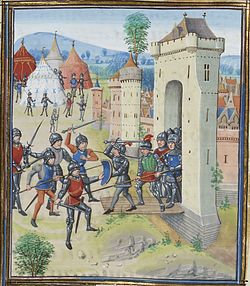
295 m
The siege of Aiguillon, an episode in the Hundred Years' War, began on 1 April 1346 when a French army commanded by John, Duke of Normandy, laid siege to the Gascon town of Aiguillon. The town was defended by an Anglo-Gascon army under Ralph, Earl of Stafford.
In 1345 Henry, Earl of Lancaster, was sent to Gascony in south-west France with 2,000 men and large financial resources. In 1346 the French focused their effort on the south west and, early in the campaigning season, an army of 15,000–20,000 men marched down the valley of the Garonne. Aiguillon commands both the Rivers Garonne and Lot, and it was not possible to sustain an offensive further into Gascony unless the town was taken. Duke John, the son and heir apparent of Philip VI, laid siege to the town. The garrison, some 900 men, sortied repeatedly to interrupt the French operations, while Lancaster concentrated the main Anglo-Gascon force at La Réole, some 30 miles away, as a threat. Duke John was never able to fully blockade the town, and found that his own supply lines were seriously harassed. On one occasion Lancaster used his main force to escort a large supply train into the town.
In July the main English army landed in northern France and moved towards Paris. Philip VI repeatedly ordered his son, Duke John, to break off the siege and bring his army north. Duke John, considering it a matter of honour, refused. By August, the French supply system had broken down, there was a dysentery epidemic in their camp, desertion was rife and Philip VI's orders were becoming imperious. On 20 August the French abandoned the siege and their camp and marched away. Six days later the main French army was decisively beaten in the Battle of Crécy with very heavy losses. Two weeks after this defeat, Duke John's army joined the French survivors.
372 m
The canton of Le Confluent is an administrative division of the Lot-et-Garonne department, southwestern France. It was created at the French canton reorganisation which came into effect in March 2015. Its seat is in Aiguillon.
It consists of the following communes:

579 m
Aiguillon is a railway station in Aiguillon, Nouvelle-Aquitaine, France. The station is located on the Bordeaux–Sète railway. The station is served by TER services operated by SNCF.

1.5 km
The Lot, originally the Olt, is a river in France. It is a right-bank tributary of the Garonne. It rises in the Cévennes mountains, flowing west through Quercy, where it flows into the Garonne near Aiguillon, a total distance of 485 kilometres. It gives its name to the départements of Lot and Lot-et-Garonne.
The Lot is prone to flooding in the winter and spring, and has many dams in its upper catchment area, mainly on the Truyère, which produce hydroelectric power of strategic importance for the French national grid. Turbining can cause additional variations in flow throughout the 275 km of the river that has been extensively developed as an asset for tourism in the region. The major project to restore navigability of the river Lot was conceived by local stakeholders in Decazeville and Cahors in the 1970s. It meant restoring the many locks, and bypassing the medium-head dams built at five locations along the former waterway.
Olt is also the name of a river in Romania.