


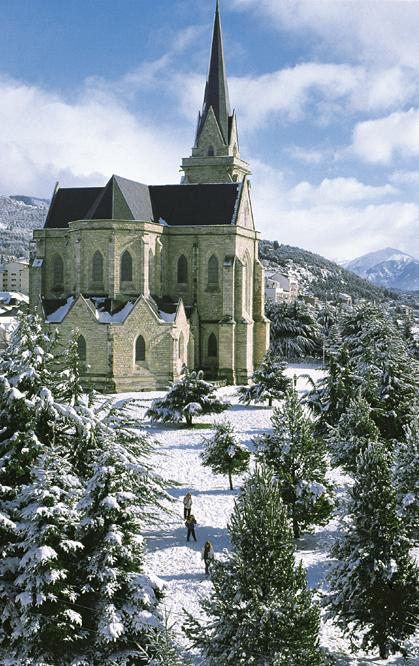
La cathédrale Notre-Dame-du-Nahuel-Huapi (en espagnol : Catedral de Nuestra Señora del Nahuel Huapi) ou plus simplement cathédrale de Bariloche est un édifice néogothique d'Argentine, construit dans les années 1940 et siège du diocèse de la ville de San Carlos de Bariloche (souvent juste appelée « Bariloche ») en Patagonie, province de Río Negro.
Gallery



Sponsored
Location
1 explorer visited this place

2 m
The Cathedral of Our Lady of Nahuel Huapi Also Cathedral of Carlos de Bariloche is the main Catholic cathedral within the city of San Carlos de Bariloche, in Patagonia Argentina. It is located on large plot of land close to the Nahuel Huapi Lake, surrounded by beautiful gardens, and is within the Diocese of Bariloche, suffragan of the Archdiocese of Bahía Blanca.
For the construction of the cathedral of Bariloche, the architect Alejandro Bustillo offered his project for free. His sentiment was oriented in a Gothic Revival style with French reminiscences.
It was built between 1942 and 1944. The stained glass windows were laid in 1947.

583 m
The Francisco P. Moreno Museum of Patagonia is a natural history and cultural anthropology museum located in the Civic Center of Bariloche, Argentina.

1.9 km
San Carlos de Bariloche, commonly known simply as Bariloche, is the largest city in the Argentine province of Río Negro and the seat of the department of the same name. It is located in the foothills of the Patagonian Andes on the southern shore of Nahuel Huapi Lake, near the border with Chile. With a population of 135,755 according to the 2022 census, Bariloche is a mid-sized city by national standards but holds significant regional importance. It is not only the most populous city in its province but also the largest in the Patagonian Andes, and the third largest in the entire Argentine Patagonia, following Neuquén and Comodoro Rivadavia. Its urban zone is characterized by its low density and has an area of more than 220 square kilometres, extending longitudinally from east to west for about 50 kilometres.
Bariloche's economy is strongly based on tourism; it is the country's third most visited destination after Buenos Aires and Mar del Plata. It is the most popular city in all of Patagonia. It attracts visitors year-round for its scenic natural setting including Nahuel Huapi National Park and other reserves, offering a range of activities such as skiing in winter and water sports and hiking in summer, alongside diverse accommodations and dining options. The nearby Cerro Catedral is the largest ski resort in South America.
The city is a traditional hub for student tourism in Argentina, and is a destination for the customary high school graduation trips. In addition it attracts families from Argentina and neighboring countries celebrating their daughter's Quinceañera.
In 2012, the Argentine Congress passed a resolution declaring Bariloche the "National Capital of Adventure Tourism". In addition to tourism, scientific activities are of growing importance for the city, as it hosts the National Atomic Energy Commission's Bariloche Atomic Centre, as well as the public universities of Comahue, Río Negro and the National Technological.
5.5 km
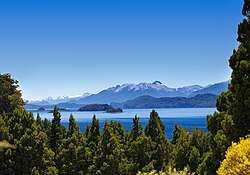
Nahuel Huapi Lake is an Andean lake in the lake region of northern Patagonia between the provinces of Río Negro and Neuquén, in Argentina. The lake has a northwest-southeast elongated shape and complex geography with several branches, peninsulas and islands. The city of Bariloche is on the southern shore of the lake and the town of Villa La Angostura lies on its northwestern shores. The lake is wholly inside Nahuel Huapi National Park. It is one of the largest lakes in northern Patagonia. It is drained by Limay River and it is part of the watershed of Negro River which discharges into the South Atlantic.

6.3 km
Cerro Otto is a mountain located 5 kilometres from San Carlos de Bariloche, and inside the Nahuel Huapí National Park, in Patagonia, Argentina.
Elle est dédiée à la Vierge Marie et nommée d'après la mission jésuite du Nahuel Huapi (es), qui tire elle-même son nom du lac Nahuel Huapi.