


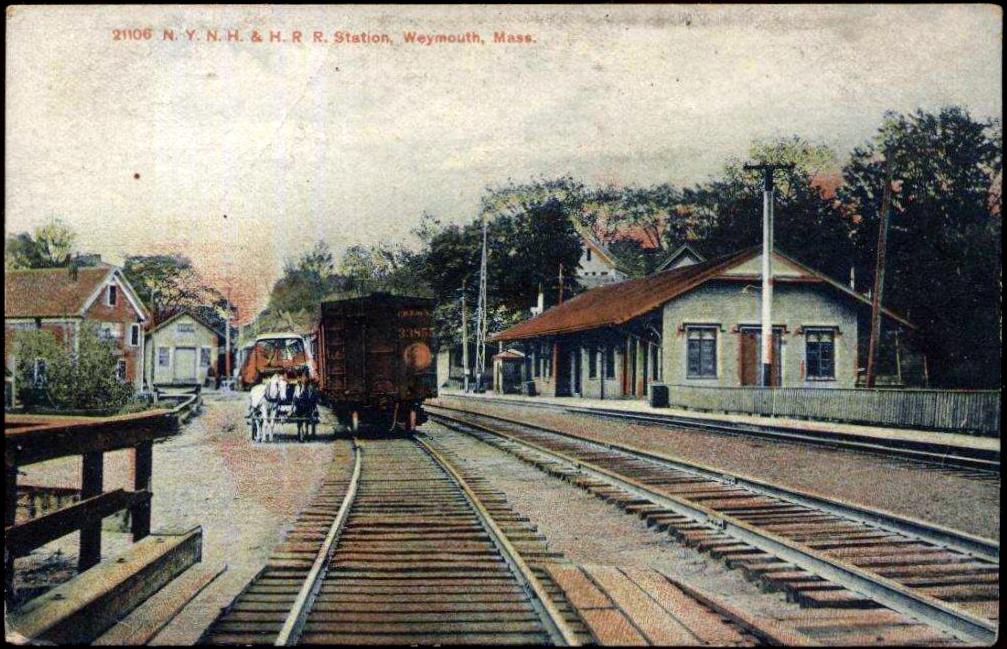
Weymouth Landing/East Braintree station (signed as East Braintree/Weymouth Landing) is an MBTA Commuter Rail station on the border of Braintree and Weymouth, Massachusetts. It serves the Greenbush Line. It is located in Weymouth Landing, and consists of a single side platform serving the line's one track. The station is fully accessible.
Gallery

Sponsored
Location

238 m
The Monatiquot River is a 4.9-mile-long river in Braintree, Massachusetts, formed by the confluence of the Farm River and Cochato River in the Braintree Municipal Golf Course, flowing in swampy meanders to the northeast, and emptying into the tidal Weymouth Fore River estuary. The name roughly translates to either “at the deep tidal place” or “lookout place”. Its drainage area is 28.7 square miles.
The river was a key aspect of colonial Braintree for its river herring. Later its strong flow was useful for early industry such as grist mills. It has remained a relatively clean river to date, with wildlife including birds, turtles, muskrats and fish, but recently has been polluted by sediments from the Graziano Inc. concrete batching operation.
The river was also where Paul Revere opened a nail mill, which remained open after his death until the 1860s, when the Mill was retooled. That nail company has since moved to southeastern Massachusetts and is still in business today producing nails on the same equipment installed during that 1860s retooling.
The river is home to a variety of aquatic life. Rainbow smelt use the river as a spawning ground and the smelt that spawn here provide fishing opportunities in the surrounding area.

386 m
The US Post Office-Weymouth Landing is a historic post office building at 103 Washington Street in Weymouth, Massachusetts. The single story stone building was built in 1941, and is locally distinctive as a rare construction in granite. The basic design of the building is similar to other post office designs of the 1930s and 1940s. It has a five-bay facade, three of which project, providing the entrance. The building is topped by a side-gable roof with a wooden cornice, with a louvered belfry topping the roof.
The building was listed on the National Register of Historic Places in 1986.

1.3 km
The Front Historic District is a predominantly residential historic district in Weymouth, Massachusetts. From the 18th to the 20th century, the area encompassed by this district was one of the more fashionable and desirable neighborhoods adjacent to the commercial Weymouth Landing area. It also contains remnants of a once-flourishing small scale shoe manufacturing industry. The 77-acre district includes nearly 150 resources, primarily residential houses, as well as a school, two cemeteries, and a small cluster of commercial buildings. The district was added to the National Register of Historic Places in 2011.
The district is focused on the northern stretch of Front Street, extending roughly from Washington Street in the north to Congress Street in the south. It also includes rows of properties along Summer Street from its junction with Front Street to Kingman Street, as well as Franklin and Broad Streets; individual properties lie on other streets immediately adjacent to the included sections of Front and Summer Streets.
The geographically largest portions of the district are the Weymouth Village Cemetery, at its southeastern corner, Weston Park in its northeast, and the Hunt Street School property. The oldest building in the district is a Cape Style house built c. 1720 at 160 Front Street; there are other 18th century Cape and Georgian style homes on Front and Summer Streets. One example of a 19th-century shoemaker's shop that survives is the building at 99 Front Street, now converted to a residence. Smaller shops, which have been converted to garages or other outbuildings, also survive at 131 and 204 Front Street.
1.8 km
Weymouth Fore River is a small bay or estuary in eastern Massachusetts and is part of the Massachusetts Bay watershed.
The headwater of Weymouth Fore River is formed by the confluence of the Monatiquot River and Smelt Brook in the Weymouth Landing area of Braintree. From Weymouth Landing, the tidal river marks the boundary between Braintree and Weymouth, flowing northeast for 0.5 miles and then north for 0.5 miles before widening considerably and turning west northwest for 0.7 miles. At this point the river's western shore is now in Quincy at the south end of the former Fore River Shipyard. Here the river turns north northeast for 1.0 mile as it passes through a heavily industrialized area around the former shipyard and is crossed by the Fore River Bridge, a lift bridge which carries Massachusetts Route 3A between Quincy and Weymouth. A quarter mile beyond the bridge Weymouth Fore River is joined by Town River at Germantown, gradually widening to nearly 1 mile as it travels the final 2.0 miles northeast before ending as it enters Hingham Bay.
Recreation along Weymouth Fore River includes Smith Beach/Watson Park in East Braintree along the northwest shore near Weymouth Landing at the river's south end and Wessagussett Beach on the southeast shore in North Weymouth before the river enters Hingham Bay. The United States Naval Shipbuilding Museum located in Quincy Point at the west end of the Fore River Bridge features USS Salem, a preserved heavy cruiser which is open to the public.
The major commercial enterprises located in the heavily industrialized area around the former shipyard include:
Braintree
Citgo Petroleum Corporation, major oil and gasoline distribution terminal
Quincy
Daniel J. Quirk, Inc., motor vehicle storage and distribution facility
Jay Cashman, Inc., heavy construction and marine equipment services
Massachusetts Water Resources Authority, sewage sludge heat-drying and pelletizing facility
Quincy Bay Terminal Company, short line freight rail service to CSXT South Braintree
Twin Rivers Technologies LP, oleochemical and biofuel production
Weymouth
Calpine Fore River Generating Station, natural gas and oil electricity generation

2.0 km
Fore River Shipyard was a shipyard on Weymouth Fore River in Braintree and Quincy, Massachusetts, that built hundreds of ships for military and civilian customers from 1883 to 1986.
The yard was founded in Braintree by Thomas A. Watson and Frank O. Wellington; it moved to Quincy Point in 1901. In 1913, it was purchased by Bethlehem Steel, and later transferred to Bethlehem Shipbuilding Corporation. It was sold to General Dynamics in 1963 and closed in 1986.
Most of the ships at the yard were built for the United States Navy. Its first government contract, for the destroyer USS Lawrence, was followed by many others, including the battleship USS Massachusetts, the cruisers USS Springfield and USS Salem; and the aircraft carrier USS Lexington and its successor USS Lexington. The yard built early submarines for Electric Boat, including USS Octopus and USS Sunfish. For foreign navies, Fore River produced five Type 1 submarines for the Imperial Japanese Navy, ten submarines for the Royal Navy, and the battleship ARA Rivadavia for the Argentine Navy.
The yard built several merchant marine ships, including Thomas W. Lawson, the largest pure sailing ship ever built, and SS Marine Dow-Chem, the first ship built to carry refrigerated chemicals. General Dynamics Quincy Shipbuilding Division, as it eventually came to be known, ended its career as a producer of LNG tankers and merchant marine ships.
The yard also built passenger liners, including Matson Line's SS Mariposa, SS Monterey, and SS Lurline and American Export Lines' SS Independence and SS Constitution.
It was home to the second-largest shipbuilding crane in the world. It had two sub-yards: the Victory Destroyer Plant in Quincy during World War I and the Bethlehem Hingham Shipyard in Hingham during World War II. The yard also owned Bethlehem Atlantic Works, a drydock in East Boston.
One theory holds that the yard was the origin of the "Kilroy was here" graffito.