


The Wolves are three small rocky islets just over a mile northwest of the island of Flat Holm in the Bristol Channel. They measure approximately 25 metres by 20 metres and have been responsible for the wrecking of at least two ships:
1817 — the William & Mary struck one of the islets and sank within 15 minutes.
Location
1 explorer visited this place
1.7 km
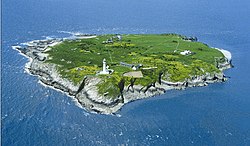
Flat Holm is a Welsh island lying in the Bristol Channel approximately 6 km from Lavernock Point in the Vale of Glamorgan. It includes the most southerly point of Wales.
The island has a long history of occupation, dating at least from the Bronze Age. Religious uses include visits by disciples of Saint Cadoc in the 5th–6th century AD, and in 1835 it was the site of the foundation of the Bristol Channel Mission, which later became the Mission to Seafarers. A sanatorium for cholera patients was built in 1896 as the isolation hospital for the port of Cardiff. Guglielmo Marconi transmitted the first wireless signals over open sea from Flat Holm to Lavernock. Because of frequent shipwrecks, a lighthouse was built on the island, which was replaced by a Trinity House lighthouse in 1737. Because of its strategic position on the approaches to Bristol and Cardiff a series of gun emplacements, known as Flat Holm Battery, were built in the 1860s as part of a line of defences, known as Palmerston Forts. On the outbreak of World War II, the island was rearmed.
It forms part of the City and County of Cardiff and is now managed by Cardiff Council's Flat Holm Project Team and designated as a Local Nature Reserve, Site of Special Scientific Interest and a Special Protection Area, because of the maritime grassland and rare plants such as rock sea-lavender and wild leek. The island also has significant breeding colonies of lesser black-backed gulls, herring gulls and great black-backed gulls. It is also home to slow worms with larger than usual blue markings.
3.1 km
Lavernock Battery was built at Lavernock Point, Wales on the recommendations of the 1860 Royal Commission during the late 1860s to protect the ports of the Severn Estuary. It was replaced by a new anti-aircraft battery during World War II that was equipped with four heavy anti-aircraft guns.

3.2 km
Lavernock is a hamlet in the Vale of Glamorgan in Wales, lying on the coast 7 miles south of Cardiff between Penarth and Sully, and overlooking the Bristol Channel.

3.9 km
Sully Island is a small tidal island of 14.5 acres by the hamlet of Swanbridge in the Vale of Glamorgan, Wales. It is located 400 m off the northern coast of the Bristol Channel, midway between the towns of Penarth and Barry and 10 km south of the Welsh capital city of Cardiff. It is part of the parish of Sully, after which it is named, and is registered as a Site of Special Scientific Interest. Sully island is one of 43 unbridged tidal islands that can be reached on foot from the mainland of Great Britain.
Access to the island is on foot at low tide from the car park of the Captain's Wife pub. A rocky causeway connecting the island to the mainland is uncovered for approximately 3 hours either side of low tide, the island being cut off from the mainland for the rest of the day. A tide table is displayed to indicate when it is safe to cross.
During the 13th century, the island was the base for Alfredo de Marisco, a Norman pirate known locally as the Night Hawk. In the Middle Ages the island was well known for its involvement in the local smuggling trade.
4.0 km
Lavernock railway station served the coastal village of Lavernock in South Wales until the 1960s.
54 passengers were lost, 50 of whom were recovered and buried on Flat Holm. There were 15 survivors. 1917 — the Swansea Packet, sank with all 60 passengers and crew.