


La région de Ribeirão Preto est l'une des 15 mésorégions de l'État de São Paulo. Elle regroupe 66 municipalités groupées en 7 microrégions.
Location
0 m
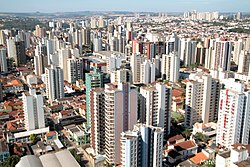
Ribeirão Preto is a city and a metropolitan area located in the northeastern region of São Paulo state, Brazil.
Ribeirão Preto is the eighth-largest municipality in the State with 650.9 km2. It has an estimated population of 720,216 in 2021 and a metropolitan area of 1,178,910. It is located 313 km from the city of São Paulo and 706 km from Brasília, the federal capital. Its mean altitude is 526.8 m high. The city's average temperature throughout the year is 23 °C, and the original predominant vegetation is the Atlantic Forest.
The city originated around 1856 as an agricultural region. Coffee was a primary income source until 1929 when it lost value when compared with the industrial sector. In the second half of the 20th century, investment in health, biotechnology, bioenergy, and information technology led to the city being declared a Technological Center in 2010. These activities have caused the city to have the 30th biggest gross national in Brazil.
The city is also an important cultural center. The Mayor Luiz Roberto Jábali Park, the Maurilio Biagi Park, Carlos Raya Park, Santa Tereza Reserve, and the Zoo are important preservation areas. Pinguim Beerhouse, Pedro II Theatre, and projects such as Ribeirão Preto's Cinema Center are relevant sightseeing points, along with events such as the Agrishow Agricultural Fair, Ribeirão Rodeo Music, Joao Rock Music Festival, and the National Outdoor Book Fair.
429 m
The Roman Catholic Archdiocese of Ribeirão Preto is an archdiocese located in the city of Ribeirão Preto in Brazil.
Bishop Moacir Silva, until then serving as the Bishop of the Roman Catholic Diocese of São José dos Campos, was named to serve as the next Metropolitan Archbishop-elect of the Roman Catholic Archdiocese of Ribeirão Preto by Pope Francis on Wednesday, April 24, 2013. He is the tenth ordinary and eighth Archbishop, and succeeds Archbishop Joviano de Lima Júnior, S.S.S., a Pope Benedict appointee who had died in office in June 2012. Silva was born on July 16, 1954, in São José dos Campos, Brazil, in Sao Paulo State, the see city of the Roman Catholic Diocese of São José dos Campos which he eventually headed. He completed preparatory studies at the Minor Seminary of Taubate, Brazil, and then completed his undergraduate philosophy studies at the Bom Jesus Seminary of the Roman Catholic Archdiocese of Aparecida in Aparecida, Brazil. Archbishop-elect Silva then completed his graduate studies in theology at the Theological Institute Sagrado Coração de Jesus of Taubate. He is trained in Canon Law, having obtained the Licentiate of Canon Law from the Pontifical Faculty of Theology Nossa Senhora da Assunção in the Roman Catholic Archdiocese of Sao Paulo in Sao Paulo, Brazil, and having also graduated from the Pontifical Lateran University in Rome, Italy.
He was ordained a priest on December 6, 1986, and was incardinated in the Roman Catholic Diocese of São José dos Campos. He then held the following positions: Diocesan Youth Pastoral Coordinator; Diocesan Coordinator of Pastoral Care in Health; Parochial Vicar of the Diocesan Cathedral Parish; Parish Pastor, Coração de Jesus Parish Church; a Member of the Diocesan Presbyteral Council and College of Consultors; Diocesan Coordinator of Pastoral Care of the Family; Parish Administrator of the Diocesan Cathedral Parish; Vicar General of the Diocese; Director of the School for the Diaconal Training Program; Judge of the Interdiocesan Tribunal at the Roman Catholic Archdiocese of Aparecida in Aparecida; Parish Pastor of the Diocesan Cathedral Parish São Dimas; Diocesan Administrator.
On October 20, 2004, he was appointed Bishop of the Roman Catholic Diocese of São José dos Campos by Pope John Paul II in the last months of his pontificate. He received episcopal ordination on December 11, 2004.
From 2008, he has served as a member of the Brazilian National Episcopal Commission for Ecclesiastical Courts of Second Instance, and in 2011 he became Vice Chairman of the Regional Bishops' Conference of the State of Sao Paulo.
429 m
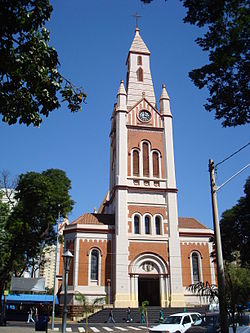
The Cathedral of St. Sebastian, also referred to as Ribeirão Preto Cathedral, is the seat of the Roman Catholic Archbishop of Ribeirão Preto and the main Catholic church in Ribeirão Preto, São Paulo, Brazil.
The population of the city expanded greatly after its 1856 founding as coffee cultivation brought wealth to the region. Construction on the first church, also called “velha Matriz”, began in 1866 and was finished in 1870, in what is now the XV de Novembro Square. Barely two decades later, the towers of this building collapsed, and in 1892 a commission of leading townspeople was formed to build a more grandiose replacement. Design and construction was repeatedly halted and restarted over the next decade owing to differing visions for the structure as well as a lack of funds. The cornerstone of the current building was finally laid March 3, 1904 with construction continuing for the next four years. In 1909, Pope Pius X erected the Diocese of Ribeirão Preto, and St. Sebastian's was named its cathedral.
The cathedral buildings and its surrounding campus were declared protected by the Council for the Defense of Historical, Archaeological, Artistic and Tourist Heritage in 2014.

815 m
Faculdade de Medicina de Ribeirão Preto is a medical school of the University of São Paulo located in the city of Ribeirão Preto, state of São Paulo, Brazil. It was founded in 1952.
FMRP-USP is the second medical school of the University of São Paulo, alongside Faculty of Medicine of the University of São Paulo, located in the city of São Paulo, and
Bauru Faculty of Medicine of the University of São Paulo, located in Bauru.
Its main campus is located in a charming old coffee farm in the outskirts of the city, with a total built area of 38,205 m2, including a small lake. It has a central building with the main departments for the basic medical sciences and an adjoining University Hospital, with 847 beds. In 2003, the hospital provided in-patient care to 33,973 persons and out-patient care to approximately 588,000. All medical care is provided free of charge.
It is considered one of the three best medical schools in the country and a premier medical research center.

2.2 km
Estádio Dr. Francisco de Palma Travassos, usually known as Estádio Palma Travassos, is a multi-use stadium in Ribeirão Preto, Brazil. It is currently used mostly for football matches and it is the home stadium of Comercial. The stadium has a capacity of 34,800 people. It was built in 1964.
Estádio Palma Travassos is owned by Comercial Futebol Clube. The stadium is named after Francisco de Palma Travassos, who donated the groundplot where the stadium was built.
