


South Woodford est une zone anglaise située au nord-est de Londres, dans le borough londonien de Redbridge.
Book your tour near
South Woodford
Book Now
4.2
in partnership with
GetYourGuide.com
Location

5 m
South Woodford is an area of East London, England, within the London Borough of Redbridge. It adjoins Woodford Green to the north, Walthamstow to the west, Snaresbrook and Wanstead to the south and Redbridge to the east, and is 8.9 miles north-east of Charing Cross. Epping Forest runs adjacent to South Woodford in the west of the area.

245 m
South Woodford is a London Underground station in the suburb of South Woodford in east London. It is on the Central line, between Snaresbrook and Woodford stations. It is in London fare zone 4.
340 m
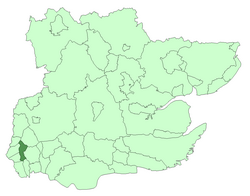
Wanstead and Woodford was a local government district from 1934 to 1965 in southwest Essex, England. A merger of two former urban districts, it was suburban to London and part of the Metropolitan Police District.

620 m
St Mary's Church, Woodford is the ancient parish church for Woodford in the London Borough of Redbridge.
It is known to have existed by the 12th century. Its rector in the 1520s was John Larke. Its medieval west tower and spire were in dangerously poor repair by 1705 and in 1708 it was replaced with a brick tower The medieval church was substantially rebuilt in brick in the Gothic style in 1816. Population expansion led to the construction of the new churches of St Paul's in 1854 and All Saints in 1874, both within the parish.
The church was completely rebuilt in 1971-72., following an arson attack in 1969, so the interior is modern.
Before the fire, the interior contained several wall monuments and tombs, including the tomb of Bridget, widow of Alexander Staples and eldest daughter of Sir John Ernle, Chancellor of the Exchequer to Charles II and James II. The church is fitted with a 3-manual Grant, Degens and Bradbeer Organ which was built at a similar time to the organ of New College Oxford. The church was completely rebuilt in 1971-72.
The church has a ring of eight bells cast at the nearby Whitechapel Bell Foundry. The churchyard hosts one of the Great Trees of London, a Copper Beech.

685 m
Woodford Hall was a large house in Woodford, Essex, with 50 acres of land adjacent to Epping Forest.
In 1707, Sir Richard Child sold the Hall to Christopher Crowe, who sold it to William Hunt in 1728, having obtained a private act of Parliament, Crowe's Estate Act 1727. It remained in the Hunt family until 1801, when it was sold to the politician John Maitland.
It was built or rebuilt in 1775 by the architect Thomas Leverton. In 1777, it was leased to John Goddard, a Rotterdam merchant, whose widow died there in 1814, after which Maitland moved in, dying there in 1831.
William Whitaker Maitland, his son, inherited the property, and leased it to William Cox, and in 1840, to William Morris, father of William Morris the textile designer, poet, and socialist activist, then aged 6. In 1847, his father died unexpectedly, and in 1848, the family moved nearby to the smaller Water House.
In 1869 the Woodford Hall estate was sold to British Land for redevelopment, but was used as Mrs. Gladstone's convalescent home until 1900, when it was demolished.
In 1902, the Parish Church Memorial Hall was built at the front of the site.
Notes et références
(en) Cet article est partiellement ou en totalité issu de l’article de Wikipédia en anglais intitulé « South Woodford » (voir la liste des auteurs).