


Casa di Ludovico Ariosto
La casa di Ludovico Ariosto (littéralement « maison de Ludovico Ariosto » - dit l'Arioste) est un édifice situé dans l'addizione Erculea à Ferrare en Émilie-Romagne.
Book your tour near
Casa di Ludovico Ariosto
Book Now
4.2
in partnership with
GetYourGuide.com
Gallery

Sponsored
Location
1 explorer visited this place

422 m
Palazzo Prosperi-Sacrati is a Renaissance-style palace located on Corso Ercole I d'Este in Ferrara, region of Emilia Romagna, Italy. The palace with its protruding marble portal and balcony, and with a corner balcony and pilaster on the corner with Corso Biagio Rossetti, was designed and built in 1493-1498 by Biagio Rossetti as part of the Addizione Erculea. It is flanked on the ground floor by marble pilasters. It is across the Corso Rossetti from the lateral facade of the Palazzo dei Diamanti.
440 m
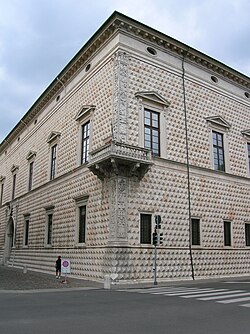
Palazzo dei Diamanti is a Renaissance palace located on Corso Ercole I d'Este 21 in Ferrara, region of Emilia Romagna, Italy. The main floor of the Palace houses the Pinacoteca Nazionale di Ferrara.

449 m
The Addizione Erculea or Erculean Addition is the area of urban expansion created in 1492 by the enlargement of the walled city limits of Ferrara, Italy. It is celebrated as an example of Renaissance urban planning.
The walled medieval city of Ferrara was geographically limited from southward expansion by a branch of the delta of the Po river. In 1450, the prior Duke, Borso d'Este had enlarged slightly the city southward with reclaimed land from the river banks.
However, Ercole d'Este had suffered from attacks and sieges from Venice to the north and the Papal states to the South. In 1492, in order to accommodate the burgeoning city and create a more daunting city-fortress to withstand sieges, Ercole d'Este commissioned plans from the architect Biagio Rossetti for an urban expansion north of the city. The walls at this border coincided with the north flank of the Castello Estense. These walls were razed and the moat, present Corso Giovecca, was filled in. Unlike the dense haphazard tracks of the medieval center, the Addizione created a main east-west road represented now by Corso Porta Po, Biagio Rosetti, and Porta Mare; and north-south street represented by the now Corso Ercole I d'Este parting from the Castello.
The Addizione more than doubled the size of the walled town and included areas for cultivation and private parks. Among the buildings erected over the next decades and centuries in this sector were the Palazzina di Marfisa d'Este, the church of Santa Chiara, Palazzo Roverella; the Palazzo Prosperi-Sacrati; the church of Teatini; the church of San Carlo, and the 17th century Teatro Comunale.
The walls of Ferrara once spanned 13 kilometers, some 9 kilometers still stand, mainly to the north and east of the city. The Porta degli Angeli was an original Northern entrance to the Addizione Erculea.
461 m
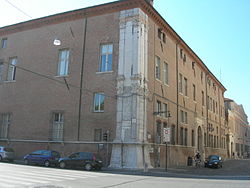
The Palazzo Turchi di Bagno is a historical palace in Ferrara at Corso Ercole I d'Este 32.
539 m
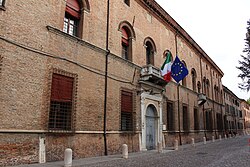
The Palazzo di Giulio d'Este is a palace located on Corso Ercole I d'Este #16 in Ferrara, Italy.