Location Image

Bishops' House

Bishops' House Maison des Évêques est une maison en colombage située dans Meersbrook Park, Sheffield. La maison fut bâtie aux environs de 1500. Bishops' House est l'un des trois exemples de maisons À colombages situées dans Sheffield, Le pub Old Queen's Head et Broom Hall sont les deux autres. L'histoire dit que la maison des évêques est appelée ainsi car elle fut construite par deux frères, John et Geoffrey Blythe, qui devinrent tous deux évêques. Il n'y a aucun indice montrant qu'ils vécurent dans la maison ; le premier résident étant William Blythe, un fermier et fabricant de faux, qui vécut là en 1627. La bâtisse est classée monument historique et était ouverte en tant que musée depuis 1976. Le musée est géré par Sheffield Galleries and Museums Trust, et contient des expositions concernant la vie aux 16e et 17e siècles avec deux pièces décorées en style Jacobain.

Nearby Places View Menu
Location Image
0 m

Bishops' House

Bishops' House is a half-timbered house in Norton Lees, a suburban area of Sheffield, England. It was built c. 1500 and is located on the southern tip of Meersbrook Park. It is one of the three surviving timber-framed houses in Sheffield (the others being the Old Queen's Head and Broom Hall). It is known as Bishops' House because it was said to have been built for two brothers, John and Geoffrey Blythe, both of whom became Bishops. There is, however, no evidence that they ever lived in this house—the first known resident is William Blythe, a farmer and scythe manufacturer, who was living here in 1627. Samuel Blyth was the last of the family to live in the house, dying in 1753, after which his sons sold the house to a William Shore. The Blyth family subsequently moved to Birmingham. Notable descendants were Benjamin Blyth, Sir Arthur Blyth and Benjamin Blyth II. The house was subsequently let to a tenant farmer and his labourer, at which point it was sub-divided into two dwellings. In 1886 ownership passed to the Corporation (Sheffield City Council) and various recreation department employees lived in the house until 1974. It is a Grade II* listed building and has been open as a museum since 1976, following a renovation funded by English Heritage and Sheffield City Council. The Sheffield Galleries and Museums Trust managed the building for some years until April 2011, when management of public opening, on behalf of the building's owner Sheffield City Council, was conferred to the Friends of Bishops' House. The displays in the house have had some recent small changes but are still curated by Museums Sheffield. The Friends of Bishops' House is a registered charity and limited company, run entirely by volunteers. The house contains exhibitions on life in the 16th and 17th centuries with two rooms decorated in Jacobean style. The building is featured on the cover of local band Monkey Swallows the Universe's second album The Casket Letters.
180 m

Meersbrook

Meersbrook (grid reference SK354841) is a neighbourhood of the Heeley area in the south-west of Sheffield, England, 2 miles south of the city centre and bordered by Norton Lees to the south and the Meersbrook allotment site (the largest allotment site in Europe) to the east. Until 1950 it was part of the Sheffield Ecclesall constituency and now forms part of the Sheffield Heeley constituency. The district falls within the Gleadless Valley ward of the city. The name comes from the stream, the Meers Brook, a tributary of the River Sheaf which means 'boundary brook' and along with the River Sheaf was the boundary between Yorkshire and Derbyshire. With the expansion and industrialisation of the City of Sheffield the area immediately south of Heeley Parish which included the fields that made up present day Meersbrook, became part of Sheffield and in turn Yorkshire. Before the building of Meersbrook and growth of Heeley the area was only made up of several small farmsteads which have given many roads their names; Rush Dale, Carfield & Cliffe Field and in 1857 was known as Mears Brook. Meersbrook grew during the industrial era when it was established after the area to the south of the River Sheaf became part of the City of Sheffield. Due to its proximity to the city centre and a thriving independent cafe, bar and restaurant culture, Meersbrook has been called 'a magnet for young professionals'. Based on 2021 census data, Meersbrook is the thirteenth least deprived of the hundred neighbourhoods in Sheffield in relation to employment, education levels, health and housing. London Road (South)/Chesterfield Road near to the neighbourhood of Meersbrook is classed as Heeley.
209 m

Norton Lees

Norton Lees (grid reference SK353839) is a residential suburb in the Graves Park ward of the City of Sheffield, England located to the east of Woodseats.
Location Image
238 m

St Peter, Greenhill

St Peter's Greenhill is a Parish Church in the Church of England Diocese of Sheffield located in the Greenhill area of the city. The church was built between 1964 and 1965 to serve the housing development that was built at what was then the edge of Sheffield. Prior to the construction of the church, the local population were served by the church of St James, Norton. The church was designed by Oxley and Bussey, and it was consecrated by the Bishop of Derby in May 1965. The church was designated a Grade II listed building in 1999.
Location Image
238 m

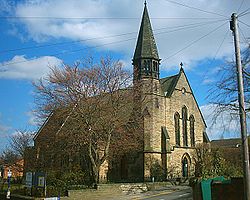
St Paul's Church and Centre, Norton Lees, Sheffield

St Paul's Church and Centre is a Parish Church in the Church of England Diocese of Sheffield located at the junction of Norton Lees Lane and Angerford Avenue, just above Meersbrook Park. For postal purposes the address is Angerford Avenue, Sheffield S8 9BG Originally built between 1875 and 1877, St Paul's was much altered to meet the needs of an expanding congregation in 1935 when C. B. Flockton added broad North and South aisles. The most recent phase of redevelopment was undertaken in 2006–7 when the church pews were removed and replaced with modern chairs, and other rooms, such as the vestry, were modernised for use as community rooms.