

 English
 Français

Corn Exchange, Arbroath
The Corn Exchange is a commercial building in the Market Place, Arbroath, Angus, Scotland. The structure, which is now used as a public house, is a Category B listed building.
Nearby Places View Menu

43 m
Arbroath Town House
Arbroath Town House is a municipal building in the High Street, Arbroath, Scotland. The town house, which was the headquarters of Arbroath Burgh Council, is a Category B listed building.
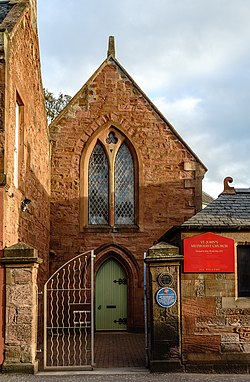
301 m
St John's Methodist Church, Arbroath
St John's Methodist Church, on Ponderlaw Street, Arbroath, Scotland, was founded by John Wesley on 6 May 1772. The nave is octagonal and the church has been nicknamed Totum Kirkie from 'totum', an eight-sided spinning top, and 'kirk', the Scottish word for church. It is a listed building and the second-oldest Methodist church in Scotland.

355 m
Arbroath
Arbroath () or Aberbrothock (Scottish Gaelic: Obar Bhrothaig [ˈopəɾ ˈvɾo.ɪkʲ]) is a former royal burgh and the largest town in the council area of Angus, Scotland, with a population of 23,902. It lies on the North Sea coast, some 16 miles (26 km) east-northeast of Dundee and 45 miles (72 km) south-southwest of Aberdeen.
There is evidence of Iron Age settlement, but its history as a town began with the founding of Arbroath Abbey in 1178. It grew much during the Industrial Revolution through the flax and then the jute industry and the engineering sector. A new harbour was created in 1839; by the 20th century, Arbroath was one of Scotland's larger fishing ports.
The town is notable for the Declaration of Arbroath and the Arbroath smokie. Arbroath Football Club holds the world record for the number of goals scored in a professional football match: 36–0 against Bon Accord of Aberdeen in the Scottish Cup in 1885.
387 m
Arbroath Catherine Street railway station
Arbroath Catherine Street railway station served the town of Arbroath, Angus, Scotland from 1839 to 1848 on the Arbroath and Forfar Railway.