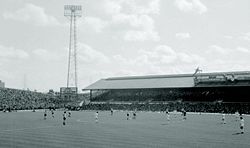
Monkwearmouth Hospital
Monkwearmouth Hospital is a mental health facility on Newcastle Road, Monkwearmouth, Sunderland, England. It is managed by the Cumbria, Northumberland, Tyne and Wear NHS Foundation Trust.
Nearby Places View Menu
505 m
Fulwell, Sunderland
Fulwell is an affluent area and former civil parish in the Sunderland district, in the county of Tyne and Wear, England. The parish was abolished in 1928 as a result of the Sunderland Corporation Act 1927, and the area incorporated into the former County Borough of Sunderland. It borders Seaburn, Southwick, Monkwearmouth, and Roker, and the district border between Sunderland and South Tyneside. Fulwell ward, including South Bents and Seaburn, is the least socially deprived of the city's 25 wards. Until 1974 it was in County Durham.
Housing in the area is varied. A network of streets in the southern area of Fulwell contains many nineteenth-century terraced houses, with a large amount of Victorian architecture. In the northern part of Fulwell, housing consists mostly of semi-detached, inter- and post-war dwellings, with many of the most popular streets constructed in the 1930s. House prices, particularly in the area's eastern and western edges, bordering Seaburn and Newcastle Road respectively, are amongst the highest in the city.
Due to Fulwell's role as an overwhelmingly residential area, economic activity in the ward is mostly restricted to the retail and leisure sectors. Local services centre on the main thoroughfare of Sea Road, where a large shopping parade has been established for many years. A mid-sized Sainsbury's store opened in 2006 at Station Road. Fulwell's fire station closed in September 2015, when services were transferred to the new station at Marley Pots. Other services include a Community Library, which is open 10 am until 4 pm on Mondays, 10 am until 5 pm on Wednesdays, 10 am until 4 pm on Fridays and 10 am until 1 pm on Saturdays, a GP clinic, two dental surgeries, and a veterinary surgery. The area is served by local bus services 23, 99, E2 and E6 as well as by the Tyne and Wear Metro, at Seaburn station. Mainline trains no longer stop at the station.
Fulwell was primarily a farming village until it became part of the urban sprawl of industrial Sunderland in the nineteenth century. Relics of this agricultural past still survive in the form of three windmills, including the 19th century Fulwell Mill, the only working windmill in the United Kingdom featuring a stone reefing stage (a design-feature peculiar to mills in north-east England, equivalent to the gallery found on other mills). The mill, built in 1808, was restored to working order between 1996 and 2001 after over half-a-century out of use, and celebrated its bicentenary in 2008. In late 2011, however, the sails and cap suffered severe storm damage. A further restoration, which included the fitting of a new fantail, cap and sails to the original dimensions, together with an overhaul of associated machinery commenced during 2017 and was completed in May 2018.
Politically, Fulwell had long been regarded as a staunch Conservative ward in a region of traditional Labour strength. Since the ward's creation it has always had at least one Conservative council. Since 2021, the ward has become a Liberal Democrat- Conservative marginal, and as of 2025 the ward has 2 Liberal Democrat councillors and 1 Conservative councillor.
Fulwell was formerly a township in the parish of Monk-Wearmouth, in 1866 Fulwell became a separate civil parish, on 1 April 1928 the parish was abolished and merged with Sunderland. In 1921 the parish had a population of 5862. It is now in the unparished area of Sunderland.
543 m
Newcastle Road
Newcastle Road was a football ground in the Monkwearmouth area of Sunderland, England, and was the home ground of Sunderland A.F.C for twelve years, between 1886 and 1898. It was the sixth ground at which the club had played. Also called Ashville Ground, it was located between Newcastle Road, Eglinton Street North and Crozier Street. Sunderland AFC's first game at the ground was a friendly against Birtley on 10 April 1886. The game ended as a 3 – 3 draw. On 5 May 1888, the now-defunct Sunderland Albion F.C. played their inaugural game at Newcastle Road; a 3 – 0 victory over Shankhouse Blackwatch, although Albion would go on to play their home games at Sunderland AFCs previous ground of Blue House Field.
Sunderland AFC became the main tenants of Newcastle Road, initially playing a mixture of friendlies and Durham Challenge Cup games. On 30 October 1886, Newcastle Road hosted Sunderland's first ever home tie in the FA Cup; a 2 – 1 victory over Newcastle West End F.C. Landowners, the Shipyard owning Thompson Sisters, charged the club £15 rent in the first year, and labourers from the Thompson yards were enlisted to help build the stands.
Sunderland joined the Football League in 1890, their first home league game being a defeat against Burnley on 13 September of that year. Six months later, in March 1891, the first England International to be held in Sunderland was played at Newcastle Road, as 15,000 spectators watched England beat Wales 4–1.
In their first season in the Football League, Sunderland drew an average home attendance of 6,091 at Newcastle Road. The ground had an estimated capacity of 15,000, but frequently admitted many more, including a then English record football attendance of 21,000 for an 1891 FA Cup tie vs Everton F.C. Over the course of the next decade, the club averaged crowds of 7,450 at Newcastle Road, peaking at 11,033 for their final season. Sunderland were hugely successful during their time at Newcastle Road, winning the league championship three times and embarking on a home run that saw them undefeated in 81 games and scoring 270 goals in the process. The success led them to be dubbed "The Team of All Talents", and Sunderland went on to be the first English side to be crowned World Champions
By 1896, rent on the ground had risen to £100, and space for expansion at Newcastle Road was limited. Recognising the need for growth, the board set about finding a new home. Sunderland became a Limited liability company, raised financing through the sale of shares, and purchased farmland in Roker for a new stadium. The final league game at the Newcastle Road was a 4–0 win over Nottingham Forest F.C. on 23 April 1898 and in the summer of 1898, Sunderland moved to Roker Park, where they would remain for 99 years.
The ground features in a painting by the artist Thomas M. M. Hemy, a brother of Charles Napier Hemy. The image depicts a game between Sunderland and Aston Villa F.C. in 1895, and is believed to be the oldest painting of a league football game. The painting was later placed in the reception area at the Stadium of Light, the current home of the club.
630 m
Seaburn Metro station
Seaburn is a Tyne and Wear Metro station, serving the suburbs of Fulwell and Seaburn, in the City of Sunderland, Tyne and Wear, England. It joined the network on 31 March 2002, following the opening of the Green line extension from Pelaw to South Hylton.
678 m
Stadium of Light Metro station
Stadium of Light is a Tyne and Wear Metro station, serving the Stadium of Light and suburbs of Roker and Monkwearmouth, City of Sunderland in Tyne and Wear. It joined the network on 31 March 2002, following the opening of the extension from Pelaw to South Hylton.
English
Français