

 English
 Français
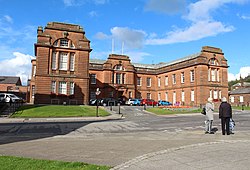
County Buildings, Dumfries
County Buildings is a municipal structure in English Street, Dumfries, Scotland. The structure, which is the headquarters of Dumfries and Galloway Council, is a Category B listed building.
Nearby Places View Menu
67 m
Greyfriars, Dumfries
Greyfriars, Dumfries, was a friary of the Friars Minor, commonly known as the Franciscans, established in Dumfries, Scotland. Following dissolution the friary was demolished and the site levelled. The locality has retained a reference to the friary in the street named "Friars Vennel". The present neo-Gothic Greyfriars was built from 1868 and is located at the site of the former Maxwell's Castle at the top of High Street.
The original friary is best known as where John "the Red" Comyn was killed by Robert the Bruce and his supporters, at the high altar in the chapel. The killing sparked the resumption of conflict with England with Bruce crowned King of Scots at Scone Palace seven weeks later. Bruce's campaign for an independent Scotland reached its culmination when the English recognised Scotland as an independent nation in the Treaty of Edinburgh–Northampton signed in 1328.

88 m

122 m
Dumfries and Galloway (UK Parliament constituency)
Dumfries and Galloway is a constituency in Scotland represented in the House of Commons of the UK Parliament by John Cooper of the Scottish Conservatives since the 2024 general election. It was first contested in the 2005 general election, replacing Galloway and Upper Nithsdale and part of Dumfries. Like all British constituencies, it elects one Member of Parliament (MP) by the first-past-the-post system of election. Despite its name, it does not cover the whole of the Dumfries and Galloway council area.

122 m
Diocese of Galloway
The Diocese of Galloway was one of the thirteen (after 1633 fourteen) dioceses of the pre-1689 Scottish Church. The Diocese was led by the Bishop of Galloway and was centred on Whithorn Cathedral.
In the Middle Ages, there was only one archdeacon, the Archdeacon of Galloway. There are three known deaneries, the deaneries of Desnes (Kirkcudbright), Farines (Wigtown) and Rhinns. The deaneries of Farines and Rhinns had been combined by the 16th century.