


Kensington Heights is a neighborhood located in the central part of Buffalo. The neighborhood is home to institutions including Burgard Vocational High School, Dr. Lydia T. Wright School of Excellence, and the Health Care Center for Children at ECMC. In 1980, the Kensington Heights housing project was 92% minority with a vacancy rate of 65%.
Location
633 m
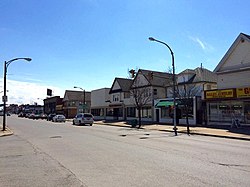
Kensington is a neighborhood of Buffalo, New York, located in the northeastern part of the city. It is sometimes referred to as Kensington-Bailey, due to the intersection at Kensington and Bailey Avenues, the two major commercial streets in the neighborhood.

675 m
Kensington Gardens Apartment Complex is a historic apartment complex located at Buffalo in Erie County, New York. It was built in 1941–1942 and is a multi-unit apartment complex containing a total of 280, one-, two- and three-bedroom apartments in a variety of detached and semi-attached buildings in the Colonial Revival style. The 59 contributing buildings are grouped around grassed courts. There are 10 court areas created on the site and three building types within the courts. It is an example of a World War II-era worker housing community built with financing by the Federal Housing Administration.
It was listed on the National Register of Historic Places in 2010.
1.0 km
Rotary Field is a field and former athletics stadium in Buffalo, New York, on the South Campus of the University at Buffalo. It was the home field for the Buffalo Bulls football teams from 1920 to 1942, and again from 1955 to 1984.
The field at Bailey Avenue and Winspear Avenue, on the southeastern corner of UB's South Campus, opened with UB's season opener against Thiel College on October 9, 1920.
The field was initially known simply as University of Buffalo Field, until the Buffalo chapter of Rotary International donated $250,000 "for the creation of a proper athletic field or stadium, and that the same shall be known as Rotary Field." Construction of bleachers with a capacity of 7,500 at Rotary Field was completed in time for the next year's season opener, another Buffalo-Thiel game, on October 8, 1921.
Rotary Field continued to serve as the Bulls' home field until 1942, when the program was suspended because of World War II. When the University of Buffalo resumed intercollegiate athletics in 1946, home games were played at Civic Stadium, the home of the NCAA's Canisius Golden Griffins and future home of the NFL's Buffalo Bills.
After drawing lackluster crowds at the 40,000-capacity NFL-sized stadium – "at some recent games, fewer than 1,000 persons have rattled around in Civic Stadium as Buffalo's team lost repeatedly", the Associated Press reported in 1954 – the University of Buffalo decided to move its football team back to the campus grounds for 1955, though for the next few years, a few home games were held at Civic Stadium.
Rotary Field served as the principal home of the Bulls until 1970, as the university dropped its football team after the end of that season. The college president noted at the time that the 12,000-person capacity stadium "had never been filled for a home game in the past decade." The sport was reinstated in 1977, again with Rotary Field as the Bulls' home turf.
The Bulls enjoyed five consecutive winning seasons at Rotary Field, 1980 to 1984, before moving to the university's North Campus in Amherst, New York, to play their home games in UB Stadium, now known as Kunz Stadium. This field, in turn, was succeeded by the present-day University at Buffalo Stadium in 1993.
The site of Rotary Field is now an open field and parking lot on the UB South Campus, across the street from the Veterans Administration Medical Center in Buffalo.

1.2 km
Frederick Law Olmsted School #156 is a high school located in Buffalo, New York. Named for the Kensington neighborhood it is located in, the building is located at 319 Suffolk Street in Buffalo. It currently serves as home to the Frederick Law Olmsted School at Kensington.

1.4 km
University at Buffalo School of Medicine and Biomedical Sciences, also known as Jacobs School of Medicine and Biomedical Sciences, is a public medical school in the city of Buffalo, New York, at the University at Buffalo. Founded in 1846, it is one of the oldest medical schools in the United States and is the only medical school in Buffalo. It is part of the State University of New York system.
It offers degrees in various field such as Biomedical Sciences undergraduate majors, Biotechnical and Clinical, Laboratory Sciences, Master's programs in Biomedical Sciences, PhD programs in Biomedical Sciences, MD program, Graduate Medical Education residency program, Continuing Medical Education, postdoctoral programs, as well as dual-degree programs.
References
Jill Babinski, Ernest Sternberg (2005). The Plaza at Kensington Heights: An Opportunity for Large-scale Retail Development in East Buffalo. Buffalo, New York: Department of Urban and Regional Planning, Graduate Workshop, University at Buffalo. p. 85.