


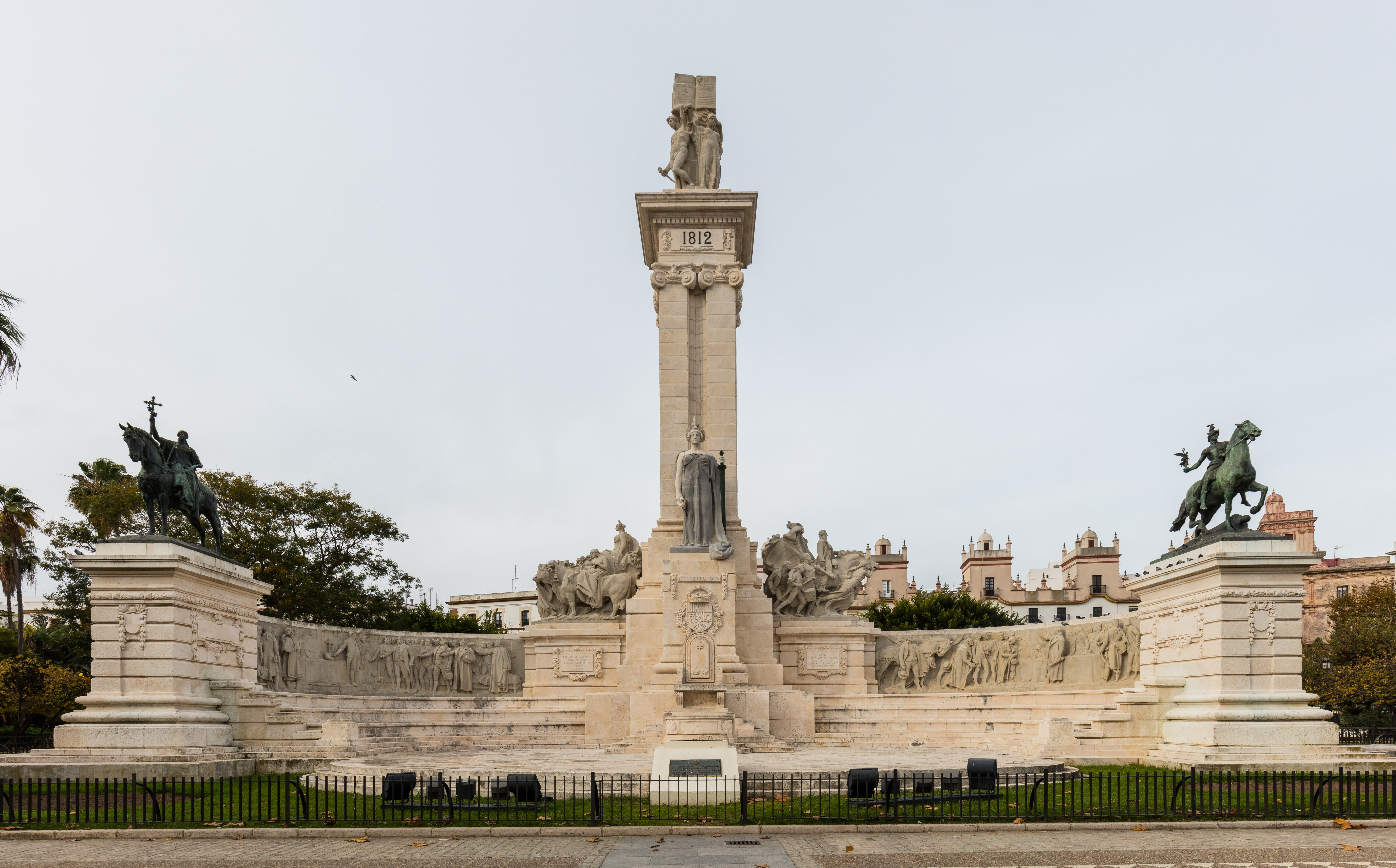
The Monument to the Constitution of 1812 is a monument in Cádiz, Spain, that commemorates the centennial of the signing of the Constitution of 1812. The monument, commissioned in 1912 and completed in 1929, is located in the centre of the Plaza de España in Cádiz.
Location

268 m
The Oratorio de la Santa Cueva is a church composed of two oratories, one superimposed above the other, adjacent to the Holy Rosary church in Cádiz.
It was restored by the Veracruz-born priest, Don José Sáenz de Santa María,
who also commissioned Haydn's The Seven Last Words of Christ for performance in the lower chapel.

298 m
The Museum of Cadiz is a museum located in Cádiz, Spain. It was founded in 1970 after the merger of the Provincial Museum of Fine Arts with the Provincial Museum of Archaeology. It is on three floors, archaeology on the ground floor, art on the first, and puppets on the second floor. Entry is free for citizens of the European Union.
The origin of the museum came in 1835, when art was confiscated from a monastery, including paintings by Zurbarán taken from the Charterhouse of Jerez de la Frontera. Other paintings included the works of Murillo and Rubens. The collection grew during the century, due to the city's Academy of Fine Arts which practised romanticism and neoclassicism. In 1877, after a Phoenician sarcophagus was found in the city's shipyard, the Archaeological Museum was founded. However, it was not until 1970 that the two institutes, despite sharing the same building, were merged. From 1980, the architect Javier Feduchi planned a reform of the building in three phases, of which two have been completed.
In addition to the 19th-century pieces, the art museum has received contemporary art from the Junta de Andalucía. Its archaeological section has also received donations, particularly of coins. Despite a range of prehistoric findings from Southern Andalusia, due to local history, it has a lack of artefacts from the Middle Ages. The "Tía Norica" set of puppets, used at the Carnival of Cádiz, was acquired by the State.

397 m
Singeing the King of Spain's Beard is the derisive name given to a series of attacks by the English privateer Francis Drake against the Spanish in the summer of 1587, beginning in April with a raid on Cádiz. This was an attack on the Spanish naval forces assembling in the Bay of Cádiz in preparation for the planned expedition against England. Much of the Spanish fleet was destroyed, and substantial supplies were destroyed or captured. There followed a series of raiding parties against several forts along the Portuguese coast. A Spanish treasure ship, returning from the Indies, was also captured. The damage caused by the English delayed Spanish preparations for the Armada by at least a year.
397 m
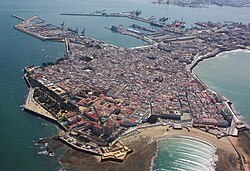
CádizD-iz, Spanish: [ˈkaðiθ]) is a city in Spain and the capital of the province of Cádiz in the autonomous community of Andalusia. It is located in the southwest of the Iberian Peninsula off the Atlantic Ocean separated from neighbouring San Fernando by a narrow isthmus. One of the oldest continuously inhabited cities in Western Europe, Cádiz was founded by the Phoenicians as a trading post. In the 18th century, the port in the Bay of Cádiz consolidated itself as the main harbour of mainland Spain, enjoying the virtual monopoly of trade with the Americas until 1778. It is also the site of the University of Cádiz.
Situated on a narrow slice of land surrounded by the sea‚ Cádiz is, in most respects, a typical Andalusian city with well-preserved historical landmarks. The older part of Cádiz, within the remnants of the city walls, is commonly referred to as the Old Town, and represents a large area of the total size of the city. It is characterized by the antiquity of its various quarters, among them El Pópulo, La Viña, and Santa María, which present a marked contrast to the newer areas of town. While the Old City's street plan consists of narrow winding alleys connecting large plazas, newer areas of Cádiz typically have wide avenues and more modern buildings. The city is dotted with parks where exotic plants flourish, including giant trees supposedly brought to the Iberian Peninsula from the New World. This includes the historic Parque Genovés.

532 m
The Monument to Moret is an instance of public art in Cádiz, Spain. Designed by Agustín Querol, it consists of a bronze statue of Liberal politician Segismundo Moret put on top of a pedestal displaying elaborated allegorical reliefs.