

 English
 Français

Warton with Lindeth
Warton with Lindeth was a civil parish in the north of Lancashire, England, from 1866 to 1935. It had an area of 4,141 acres (1,676 ha). It was a township and became a parish in 1866. It was abolished on 1 April 1935, when 3,534 acres (1,430 ha) formed the new civil parish of Warton and 607 acres (246 ha) were added to the civil parish of Silverdale (created 1866). In 1931 the parish had a population of 1694. In John Marius Wilson's Imperial Gazetteer of England and Wales (1870–72), Lindeth was described as "a hamlet in Warton parish, Lancashire; 4 ½ miles NW of Carnforth".
Nearby Places View Menu
65 m
Warton, Lancaster
Warton is a village, civil parish and electoral ward in the Lancaster district of Lancashire, England. The village is close to the boundary with Cumbria, and approximately 1.5 miles (2.4 km) north of Carnforth, which was originally part of the parish of Warton. The village had a population of 2,315 at the 2001 census, and 2,360 at the 2011 census. The parish covers an area in excess of 11,000 acres (45 km2) and is predominantly rural.
The earliest record of the Warton is in the Domesday Book of 1086. The village contains Warton Old Rectory, the ruins of a late thirteenth- or early fourteenth-century clergyman's house. The parish church, dedicated to Saint Oswald, has links to the Washington family, the ancestors of the first president of the United States of America, George Washington.

312 m
Old Rectory, Warton
The Old Rectory (also known as Parsonage Court) is a ruin of a former rectory in the village of Warton, near Lancaster, Lancashire, England. Owned by the Yearron/Bell family and under the protection of English Heritage, it has been designated a Scheduled Ancient Monument and Grade I listed building.
The rectory is believed to have been built in the early 14th century as the residence of the rector of the parish of St Oswald's, Warton, probably by two younger sons of Marmaduke, Lord Thweng. Manorial courts were also held here. The walls are of limestone rubble with sandstone dressings, and a cross passage originally separated the full-height great hall on the southern side from service rooms and a first floor chamber at the other end of the house. The doorway at the eastern end of the cross passage is interpreted as the main entrance, while the western one led into a garden, and both originally had a porch. A doorway in the northern gable wall led into a courtyard with an external kitchen and a well. In the south-west corner of the great hall is a doorway that led to another building which survives as part of the modern vicarage. The southern gable had an ogee quatrefoiled window under the apex to provide light.
It is not known exactly when the rectory was abandoned, after being replaced by a new rectory, but it was a ruin by 1721. Some time later, a cottage was constructed in the north end of the ruin, which was occupied well into the 20th century, however these additions have since been removed. The ruin is considered to be well preserved, with the gables surviving to almost their full height. It is open to visitors, free of charge.
334 m
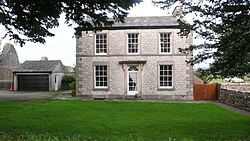
St Oswald's Vicarage, Warton
St Oswald's Vicarage is a historic building in the English village of Warton, Lancashire. Largely built in 1823 (although its rear wing dates to around 1300), it was formerly the clergy house for the nearby St Oswald's Church. It is now a Grade I listed building. It is constructed in coursed limestone. A post-war extension of the property is not of special interest.

348 m
St Oswald's Church, Warton
St Oswald's Church is in the village of Warton, Lancashire, England. It is an active Anglican parish church in the deanery of Tunstall, the archdeaconry of Lancaster, and the diocese of Blackburn. Its benefice is united with those of St Mary, Borwick and St John the Evangelist, Yealand Conyers. The church is recorded in the National Heritage List for England as a designated Grade II listed building. The ruined remains of the medieval rectory survive next to the present vicarage to the west of the church.