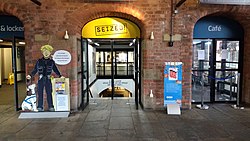
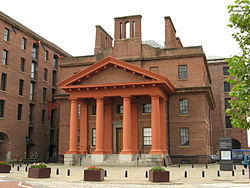
Le Merseyside Maritime Museum est un musée maritime de la ville de Liverpool dans le Comté métropolitain de Merseyside en Angleterre. C'est l'un des nombreux Musées Nationaux de Liverpool et l'un des points d'ancrage de l'ERIH, la Route européenne du patrimoine industriel. Ouvert en 1980 et agrandi en 1986, le musée occupe le bloc D d'entrepôts à l'Albert Dock, ainsi que la Maison du Piermaster, le Canning Half Tide Dock (en) et le Canning Graving Docks (en). Le patrimoine maritime de la ville est mis en valeur dans l'Albert Dock historique. Les collections du musée reflètent l'importance internationale de Liverpool comme passerelle vers le monde, y compris son rôle dans le commerce transatlantique des esclaves et de l'émigration, la marine marchande et du RMS Titanic. On y trouve aussi à quai :

le bateau-pilote Edmund Gardner (1953), le remorqueur à vapeur Daniel Adamson (1903), le remorqueur Brocklebank (1964) , le caboteur Wincham (1948) ,

Nearby Places View Menu
Location Image
0 m

Merseyside Maritime Museum

The Merseyside Maritime Museum is a museum based in the city of Liverpool, Merseyside, England. It is part of National Museums Liverpool and an Anchor Point of ERIH, The European Route of Industrial Heritage. It opened for a trial season in 1980 before fully opening in 1984 and expanding in 1986. The museum occupies warehouse block D at the Albert Dock, along with the Piermaster's House, Canning Half Tide Dock and Canning Graving Docks.
Location Image
0 m

International Slavery Museum

The International Slavery Museum is a museum located in Liverpool, UK, that focuses on the history and legacy of the transatlantic slave trade. The museum, which forms part of the Merseyside Maritime Museum, consists of three main galleries which focus on the lives of people in West Africa, their eventual enslavement, and their continued fight for freedom. Additionally the museum discusses slavery in the modern day as well as topics on racism and discrimination.
Location Image
23 m

Border Force National Museum

The Border Force National Museum (previously - UK Border Agency) is located in Liverpool, England and holds the national collection of HM Revenue and Customs, one of the most important collections of its type held anywhere in the world. Originally HM Customs & Excise National Museum, the collection is now a gallery located on the basement floor of the Merseyside Maritime Museum at the Albert Dock.
Location Image
80 m

Royal Albert Dock, Liverpool

The Royal Albert Dock is a complex of dock buildings and warehouses in Liverpool, England. Designed by Jesse Hartley and Philip Hardwick, it was opened in 1846, and was the first structure in the United Kingdom to be built from a combination of cast iron, brick, and stone without also using wood for any structural element. As a result, it was the first non-combustible warehouse system in the world. It was known simply as the Albert Dock until 2018, when it was granted a royal charter and had the honorific "Royal" added to its name. At the time of its construction, the dock was considered to be revolutionary in its design because ships were loaded and unloaded directly from or to the warehouses. Two years after it opened, it was modified to feature the world's first hydraulic cranes. Due to its open yet secure design, the dock became a popular store for valuable cargoes such as brandy, cotton, tea, silk, tobacco, ivory and sugar. However, despite its advanced design, the rapid development of shipping technology meant that, within 50 years, larger and more open docks were required, although the Albert Dock remained a valuable store for cargo. During the Second World War, the dock was requisitioned by the Admiralty serving as a base for ships of the British Atlantic Fleet. The complex was damaged during air raids on Liverpool, notably during the May Blitz of 1941. In the aftermath of the war, the financial problems of the owners and the general decline of docking in the city meant that the future of the Albert Dock was uncertain. Numerous plans were developed for the re-use of the buildings but none came to fruition and in 1972 the dock was finally closed. Having lain derelict for nearly ten years, the redevelopment of the dock began in 1981, when the Merseyside Development Corporation was set up, with the Albert Dock being officially re-opened in 1984. Today the Royal Albert Dock is a major tourist attraction in the city and the most visited multi-use attraction in the United Kingdom, outside London. The five warehouses which make up the complex cover 1.25m sq ft in size, the biggest such group of Grade I listed buildings anywhere in the UK.
Location Image
82 m

Albert Dock Traffic Office

The Albert Dock Traffic Office, officially the Dr Martin Luther King Jr Building, is a 19th-century Grade I listed building located in Liverpool, England. It is one of a series of buildings that make up the Royal Albert Dock. The building was formerly occupied by Granada Television, and is now owned by National Museums Liverpool and houses part of the International Slavery Museum.