


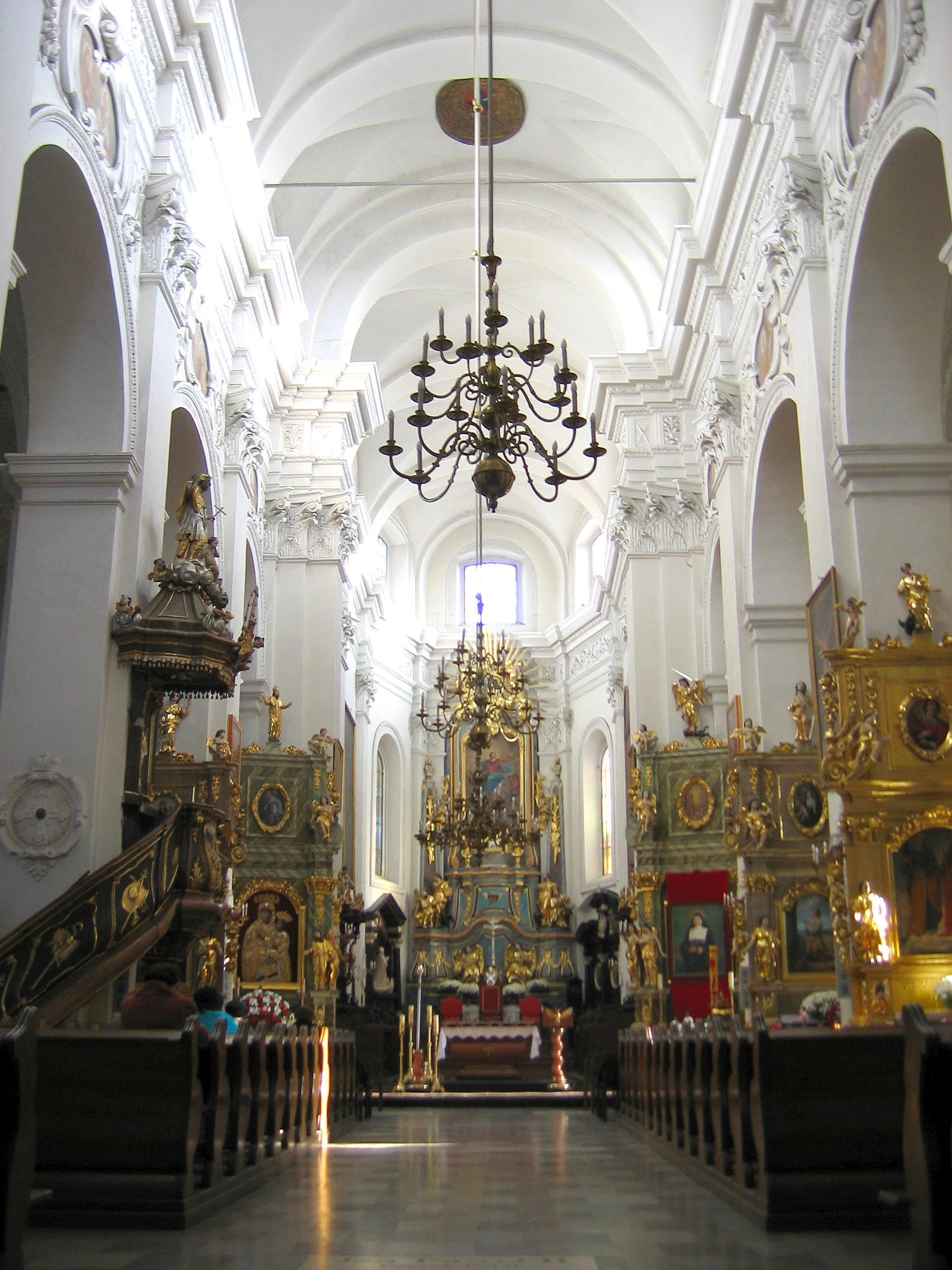
La cathédrale de l'Assomption-et-Saint-Nicolas (en polonais : Bazylika katedralna Wniebowzięcia Najświętszej Maryi Panny i św. Mikołaja), située à Łowicz, abrite les sépultures de douze archevêques de Gniezno et primats de Pologne qui avaient fait de Łowicz leur lieu de résidence. La cathédrale est l'église principale du diocèse de Łowicz. Elle figure sur la liste des monuments historiques de Pologne depuis le 13 novembre 2012.
Book your tour near
Cathédrale de l'Assomption-et-Saint-Nicolas de Łowicz
Book Now
4.2
in partnership with
GetYourGuide.com
Gallery


Sponsored
Location
1 explorer visited this place

3 m
The Cathedral Basilica of the Assumption of the Blessed Virgin Mary and St. Nicholas also called Łowicz Cathedral is a religious building affiliated with the Catholic Church and is located in the city of Łowicz in the Łódź Voivodeship, Poland.
It is a church located in the old market square, called "Mazowiecki Wawel" resting place of 12 archbishops of Gniezno and primates of Poland. On November 13, 2012, the building was included in the list of historical monuments in Poland.
Originally, this place was a wooden church funded in 1100, probably by Prince Władysław I Herman. After a new temple was built in the Gothic style. On 25 April 1433 was elevated to the rank of collegiate church.
The Temple was severely damaged during the battle of Bzura in 1939. After the war it was renewed. On 25 March 1992, Pope John Paul II created the Diocese of Łowicz, bringing the church to the dignity of the cathedral. During his Apostolic Journey the Pope visited Łowicz and June 14, 1999, granted the cathedral the title of minor basilica.

121 m
The Diocese of Łowicz is a Latin diocese of the Catholic Church located in the city of Łowicz in the ecclesiastical province of Łódż in Poland.
Its cathedral, the Cathedral Basilica of the Assumption of the Blessed Virgin Mary and St. Nicholas, stands as one of Poland's official national Historic Monuments, as designated November 13, 2012. This listing is maintained by the National Heritage Board of Poland.
In 2014, it became the first and for now the only one Polish diocese since a very long time where no deacon was ordinated a priest. About 31.3% of all Catholics in the diocese attend Sunday mass, which is lower than the average for the Polish nation as of 2013.
1.1 km
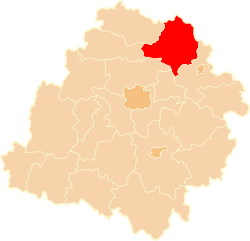
Łowicz County is a unit of territorial administration and local government in Łódź Voivodeship, central Poland. It came into being on January 1, 1999 as a result of the Polish local government reforms passed in 1998. Its administrative seat and only town is Łowicz, which lies 48 kilometres north-east of the regional capital Łódź.
The county covers an area of 987.13 square kilometres. As of 2006, its total population was 82,338, out of which the population of Łowicz was 30,204, and the rural population was 52,134.

1.1 km
Łowicz [ˈwɔvʲit͡ʂ] is a town in central Poland with 27,436 inhabitants. It is situated in the Łódź Voivodeship. Together with a nearby station of Bednary, Łowicz is a major rail junction of central Poland, where the line from Warsaw splits into two directions—towards Poznań, and Łódź. Also, the station Łowicz Main is connected through a secondary-importance line with Skierniewice.
Łowicz was a residence of Polish primates in the Polish–Lithuanian Commonwealth. They served as regents when the town became a temporary "capital" of Poland during the interregnum. As a result, Łowicz has its own bishop and a Cathedral Basilica in spite of its considerably small size. The Cathedral Basilica is designated a Historic Monument of Poland, and the ruins of a former bishop's castle can be found on the outskirts of town. Also, the town was at the centre of the largest battle of the German invasion of Poland, the Battle of the Bzura River, in the opening campaign of World War II.
Łowicz has an important ethnographic museum exhibiting Polish art and historical artifacts from the region. Also, Łowicz features a popular skansen with traditional wooden houses. It is a vast open-air display of historical structures depicting traditional Polish village-life; a collection of artifacts spread over a 17-hectare site, just outside the town.
Łowicz is a prominent site of food production, i.e. fruit and vegetable preserves and dairy products, popular in Poland and abroad.
Near the town is the Maurzyce Bridge, the first welded road-bridge in the world, built in 1928 across the river Słudwia. It was designed in 1927 by Stefan Bryła from the Lwów University of Technology.
1.1 km
Gmina Łowicz is a rural gmina in Łowicz County, Łódź Voivodeship, in central Poland. Its seat is the town of Łowicz, although the town is not part of the territory of the gmina.
The gmina covers an area of 133.38 square kilometres, and as of 2006 its total population is 7,444.