


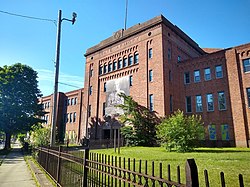
James Hillhouse High School is a four-year comprehensive public high school in New Haven, Connecticut. It serves grades 9–12. Formerly New Haven High School, it is the oldest public high school in New Haven, and is part of the New Haven Public Schools.
Book your tour near
Hillhouse High School
Book Now
4.4
in partnership with
GetYourGuide.com
Location
370 m
The New Haven Armory is a historic building at 270–290 Goffe Street in the Dixwell neighborhood of New Haven, Connecticut, United States. Developed between 1928 and 1930, the armory served the Connecticut National Guard and the Second Company Governor's Foot Guard. It has also served as a venue for concerts, events, and other civic functions in the community.
462 m
The Beaver Hills Historic District is a 97-acre historic district in the Beaver Hills neighborhood of New Haven, Connecticut. It was listed on the National Register of Historic Places in 1986. In 1986, it included 235 contributing buildings.
According to its 1986 nomination, the district is significant as a nearly intact example of an early 20th-century suburban residential subdivision. The district in 1986 was composed mostly of single-family homes built between 1908 and 1936. The most common architectural styles are Colonial Revival, Tudor Revival and Bungalow. Queen Anne, Spanish Colonial Revival, Prairie and other styles are also represented. One feature of note was the presence of "one of the city's best collections of early 20th-century garages."
Significant contributing properties in the historic district include:
Pitkin House, from 1931, a Tudor Revival style house at 207 Colony Road A 2+1⁄2-story "frame house with gable roof, front gable pavilions, stuccoed/half-timbered exterior"
Alan Krevit House, from 1936, a 2+1⁄2-story Colonial Revival style frame house with gable roof, at 186 Colony Road
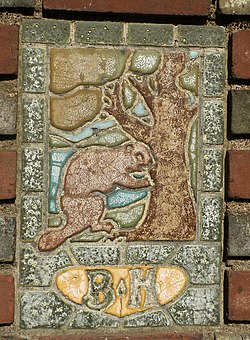
The district includes brick gateway piers at the intersections of Goffe Terrace with Norton Parkway and with Ellsworth Avenue, at the South End of the District. The piers include "tile plaques depicting beavers" and "were constructed by the Beaver Hills Company in 1908 to define the southern terminus of the neighborhood."

596 m
The Dixwell Avenue Congregational United Church of Christ is a historic church at 217 Dixwell Avenue in New Haven, Connecticut. Founded in 1820 as the African Ecclesiastical Society, the congregation has been a major part of African-American society in the city since then. Its current church building, completed in 1969, is a major local example of Brutalist architecture, designed by John M. Johansen. It was listed on the National Register of Historic Places for its architecture in 2018.

655 m
The Winchester Repeating Arms Company Historic District is a historic district in New Haven, Connecticut that was listed on the National Register of Historic Places in 1988. It includes 867 properties, which "include 858 major structures and 131 notable outbuildings." Of these structures, 876 are buildings deemed to contribute to the historical and/or architectural significance of the area, and most of these are residential. However the center of the district is "dominated" by the 75-acre tract of the former Winchester Repeating Arms Company, which contains industrial buildings.
The district includes and surrounds the old Winchester plant later run by U.S. Repeating Arms; the plant was important to both of its adjoining residential neighborhoods. Some of the plant has been operated by Science Park at Yale, a business incubator with Yale University associations.
695 m
Beaver Hills is a neighborhood in the city of New Haven, Connecticut. The older, east central portion of the neighborhood is listed on the National Register of Historic Places as the Beaver Hills Historic District. The southwest portion is a state historic district called the Fairlawn-Nettleton Historic District.
The name “Beaver Hills” dates to the Colonial era, when it was a piece of high ground near several "beaver ponds". Geologist James Dwight Dana later attributed the "Beaver Pond" to natural springs, rather than the activity of beavers.
The Beaver Hills Historic District covers 97 acres of the neighborhood north of Goffe Street and east of Ella Grasso Boulevard. It was listed on the National Register of Historic Places in 1986 and included 235 contributing buildings. The listing recognized the district's significance as a nearly intact example of an early 20th-century suburban residential subdivision. The district in 1986 was composed mostly of single-family homes built between 1908 and 1936. One feature of note was the presence of "one of the city's best collections of early 20th-century garages." The district includes brick gateway piers at the intersections of Goffe Terrace with Norton Parkway and with Ellsworth Avenue, at the south end of the district. The piers include "tile plaques depicting beavers" and "were constructed by the Beaver Hills Company in 1908 to define the southern terminus of the neighborhood." Significant contributing properties in the historic district include the Pitkin House and the Alan Krevit House