Literary and Philosophical Society of Newcastle upon Tyne
The Literary and Philosophical Society of Newcastle upon Tyne (or the Lit & Phil as it is popularly known) is a historical library in Newcastle upon Tyne, England, and the largest independent library outside London. The library is still available for both lending (to members) and as a free reference library. The society is a registered charity.
Nearby Places View Menu
48 m
North of England Institute of Mining and Mechanical Engineers
The North of England Institute of Mining and Mechanical Engineers (NEIMME), commonly known as The Mining Institute, is a British Royal Chartered learned society and membership organisation dedicated to advancing science and technology in the North and promoting the research and preservation of knowledge relating to mining and mechanical engineering. The membership of the institute is elected on the basis of their academic and professional achievements with Members and Fellows entitled to the postnominal MNEIMME and FNEIMME. The Institute's membership is predominantly from local industry and from academics at Durham and Newcastle Universities, though members are also located further afield across the UK.
The institute was founded in 1852 in Newcastle upon Tyne, and was granted a Royal Charter by Queen Victoria in 1876. The Institute developed one of the largest collections of mining information in the world. Its library, named after the first President Nicholas Wood contains more than twenty thousand volumes of technical literature, in the fields of mining, geology, mechanical engineering, government blue books, mine rescue, mineralogy, mineral chemistry, mining statistics, mining law, seismology and other related topics.
In 2019 the assets of the Institute – building, library and archive collections and staff – were transferred to a separate charity, The Common Room of the Great North, established to "celebrate the region's engineering history through education and engagement, with a vision to inspire the next generation of innovators and engineers". Neville Hall, the Institute building, was closed for refurbishment in 2019.
The Institute itself continues as an independent professional membership organisation for engineers, and is currently developing a new strategy that aims to increase its activities.
64 m
Westgate House, Newcastle upon Tyne
Westgate House was a 46-metre (150 ft) office block that was situated on Westgate Road opposite Newcastle station in the Grainger Town of Newcastle upon Tyne, England. The 12-storey Brutalist building was completed in 1972 and was demolished in 2006–07.
The building straddled the eastern end of Westgate Road, and was designed to have the appearance of a "gateway" to the city centre. After being completed, it housed several government agencies. The last to use the building was the Citizens Advice Bureau, who were based on the ground floor until 2001.
According to the Evening Chronicle, by 2001 "it was well-established as one of the ugliest and most unpopular buildings on Tyneside". The vast concrete structure was particularly criticised for being out of place with the Victorian buildings around it. Westgate House was featured on the Channel 4 television series, Demolition, where it was voted as one of twelve buildings that deserved to be demolished. However, in BBC News Magazine, it was nominated as an 'unsung landmark'.
Developers OneNorthEast acquired the building in 2001 and initially considered renovating it as a hotel. In 2005, they and Newcastle City Council instead announced that the building would be demolished, with the work beginning in late 2006 and finishing in January 2007 allowing for the site's redevelopment. Westgate House had to be taken down piece by piece as neighbouring buildings were too close to allow for a controlled explosion. Demolition started off slowly at first as a result of the unique construction method used on the 11th floor, which was a plant room, and the 12th floor which was stronger than other floors because of the roof slab. Demolition was completed upon the removal of the 'stilts' at the base of the building.
152 m
Tup Tup Palace
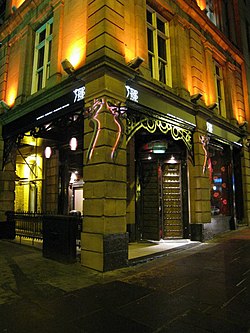
Tup Tup Palace is a nightclub in Newcastle upon Tyne, United Kingdom. It was created in 2007 by entrepreneur James Jukes and club promoters Nigel Holliday and Matthew Smyth at a cost of £2M. The major investors were Nicholas Woodhead and Scottish & Newcastle PLC. The club is located opposite Newcastle Cathedral in the city centre. The venue has a capacity of 600 people and focuses largely on table service. It has become known primarily for its celebrity customers.
155 m
St John the Baptist Church, Newcastle upon Tyne
St John's Church is a 13th-century church on the corner of Grainger Street and Westgate Road in Newcastle upon Tyne, England, dedicated to St John the Baptist. It is a Grade I listed building.
English
Français