


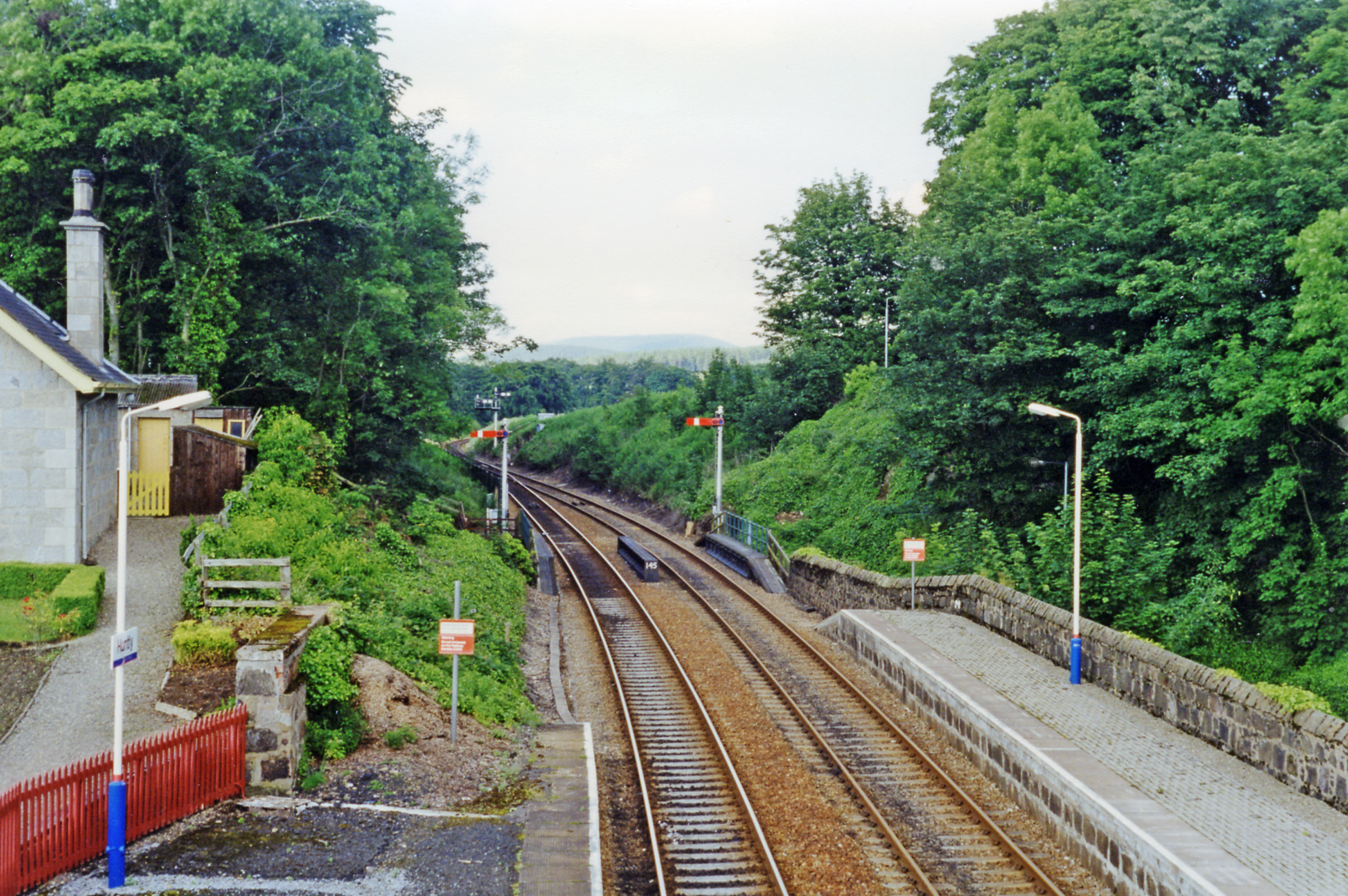
Monymusk railway station was a station on the Alford Valley Railway in Monymusk, Aberdeenshire, Scotland. The station opened on 25 March 1859 and closed on 2 January 1950. Monymusk was an intermediate station on the Alford branch of the Great North of Scotland Railway. It was a single platform station. In the course of its operations, it was grouped into the London and North-Eastern Railway.
Gallery

Sponsored
Location
1 explorer visited this place
1.1 km
Monymusk Parish Church is located in Monymusk, Aberdeenshire, Scotland. It is of Church of Scotland denomination. Now Category A listed, a structure on the site has existed since at least the late 12th or early 13th century, but it was a site of worship even before that.
Originally Monymusk Priory, today's structure has been altered several times, including post-Reformation, and in 1822, 1851 and 1921, when Alexander Marshall Mackenzie performed a partial restoration.
The clock face dates to 1865, and its Mowat bell 1748.
There are monuments to Forbes-Leslie of Abersnithick and Sir Archibald Grant and his relatives.

1.1 km
1.3 km
The House of Monymusk is a country house on the outskirts of the village of Monymusk, in the Marr area of Aberdeenshire, Scotland. It stands near the River Don. It is a Category A listed building. The village dates back to at least 1170 and was acquired by the Forbes family in the 1560s. The house originated as an L-plan tower house dating from about 1587, with additional storeys added in the 18th century and later wings constructed in the 19th century. It remained in Forbes ownership until 1712, when it was sold to the Grant family.

2.3 km
Cluny Castle was originally built c.1604 as a Z-plan castle replacing either a house or small peel tower. Sited in the parish of Cluny, it is south of Monymusk and north of Sauchen in Aberdeenshire, north-east Scotland. Owned by the Gordon baronets of Cluny and three separate branches of the family over the centuries, it was used to shelter Jacobite rebels in the mid-18th century. Extensive additions were made in 1820 to the design of architect John Smith when it was in the ownership of Colonel John Gordon. The private chapel, once completed in 1870, was described by the British press as "one of the first and most beautiful oratories in the kingdom". Two wings of the castle and the adjoining private chapel were destroyed by fire in 1926, but the damage was mostly restored.
It is a Category A listed building and has been used as a film setting. The grounds are included on the Inventory of Gardens and Designed Landscapes in Scotland and are described as 'Outstanding' in their Artistic and Historical Interest by Historic Scotland.
As of 2025 it remains privately owned by Cosmo Linzee Gordon of Cluny who has employed craftsmen to complete extensive renovations. It is not open to the public but corporate events are hosted there and weddings are held in the chapel.
3.4 km
Tillycairn Castle is a 16th-century L-plan castle standing on high ground around 2.0 miles south-east of Cluny in Aberdeenshire, Scotland. It is a Category A listed building, designated on 16 April 1971.
Subsequently, it was closed to regular passenger traffic on 2 January, 1950.
