

 English
 Français
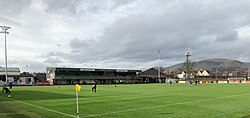
Recreation Park, Alloa
Recreation Park, also known as Recreation Grounds, The Recs and The Indodrill Stadium for sponsorship reasons, is a football stadium in Alloa, Clackmannanshire, Scotland. It is the home ground of Scottish Professional Football League team Alloa Athletic, who have played there since 1895. Additionally, Broomhill (formerly BSC Glasgow) of the Scottish Lowland Football League groundshared at Recreation Park from 2016–2022. From 2025 Stirling University's 2nd team who play in the EoSFL will groundshare going forward. Central Girls Football Academy have used the stadium for home matches from 2017. The stadium has an artificial playing surface and a capacity of 3,100.
Nearby Places View Menu
359 m
Gaberston Mill
Gaberston Mill was a weaving and spinning mill located in Whins Road Alloa, Scotland founded by David Fraser Lambert (1805–56) in 1837.

616 m
Alloa railway station
Alloa railway station is a railway station in Alloa, Clackmannanshire, Scotland.
The station was first opened in 1850 and operated until 1968. The original station building from 1850 was replaced by a new structure in 1887, which was demolished following the closure and removal of the railway lines in 1968.
The Scottish Executive funded the construction of a new railway line between Stirling and Alloa in the early 2000s, and the station was reopened on May 19, 2008.
634 m
Upper Hirst
The Upper Hirst is a coal seam in central Scotland that was mined on a large scale in the 1950s through to 2002, mainly to supply Kincardine Power Station, and later, Longannet Power Station, in Fife.
This was a low-quality coal, unsuitable for most other purposes, and had mostly been disregarded previously. Its low sulfur content made it very suitable for power station use. It burns relatively slowly making it popular in the 16th century for the manufacture of salt and glass. The seam is also known locally as the Jenny Pate or the Janet Peat.
The Upper Hirst coal is found within the Upper Limestone Group of strata, above the Limestone Coal Group, but below the Productive Coal Measures. The latter two groups of strata may be separated by up to 1,000 metres. In the Central Coal Field, which is in the form of a basin, the Productive Coal Measures, if they were ever deposited, have been lost by erosion except near the centre, where they outcrop near Alloa and Clackmannan, and have been mined until recently. The Limestone Coal Group of strata have been mined only around the edge of the basin, although in the 1950s there were plans for deep mines at Airth, where two large shafts were constructed to rockhead and then abandoned, and at Gartarry Toll, which was not begun.
At Manor Powis, for example, the useful seams in the Limestone Coal Group were at a depth of about 400 metres, and included valuable anthracite; the Upper Hirst was above this and as well as being mined at mid-shaft in the old colliery, was reached by a pair of sloping adits constructed near the bank of the River Forth. The slope of the seam was followed for some distance down the dip of the basin, to the east.
The Upper Hirst was initially mined experimentally at the site of Bannockburn colliery by a small drift mine, then at mid-shaft in Polmaise 3/4 (commonly called Fallin), Manor Powis, and later the drift mines at Dollar and Bogside, to supply Kincardine Power Station, but when Longannet Power Station was built, an innovative scheme was developed to mine the coal at Dollar, Castlehill and Solsgirth, and bring the coal from Solsgirth, Bogside and Castlehill to the surface by conveyor at Longannet, immediately adjacent to the power station. Bogside, on the eastern extremity of the basin, could access the coal at no great depth, and it was worked down the dip to the west, via a large, deep shaft at Castlehill, which was latterly used for personnel access, the coal all emerging at Longannet, except that from Dollar, which due to faulting could not be economically linked to the main conveyor system.
This scheme was a great success, although the focus of mining shifted to the south as the Dollar basin was exhausted. Eventually coal was being extracted from south of the River Forth, and there were adequate reserves to last for at least the predicted lifetime of Longannet Power Station. A disastrous flood on 23 March 2002 terminated production of the Upper Hirst coal, and brought deep mining in Scotland to an end.
The source of the flooding was allegedly the failure of a dam constructed to keep water which accumulated in the old workings to the north out of the working part of the mine, but there are substantial gaps in the known facts. A local mine manager claimed that the water, about 20 million gallons (a small amount in mining terms) could be pumped out for £55,000, which is probably much less than the redundancy payments to the approximately 200 staff when the company went into receivership in indecent haste. The investigation by HM Inspectorate of Mines is thorough and meticulous, but does not conceal the fact that nothing has been proved about what really happened underground.
Meanwhile, many tens of millions of tons of Upper Hirst coal remain inaccessible, the water level has reached the now closed adit entrance at Longannet, and the UK imported large quantities of foreign coal to burn in Longannet Power Station until its closure in 2016.

762 m
Alloa Tower
Alloa Tower in Alloa, Clackmannanshire, in central Scotland, is an early 14th-century tower house that served as the medieval residence of the Erskine family, later Earls of Mar. Retaining its original timber roof and battlements, the tower is one of the earliest and largest Scottish tower houses, with immensely thick walls. It was designated as a scheduled monument in 1960 and is now owned by the National Trust for Scotland.