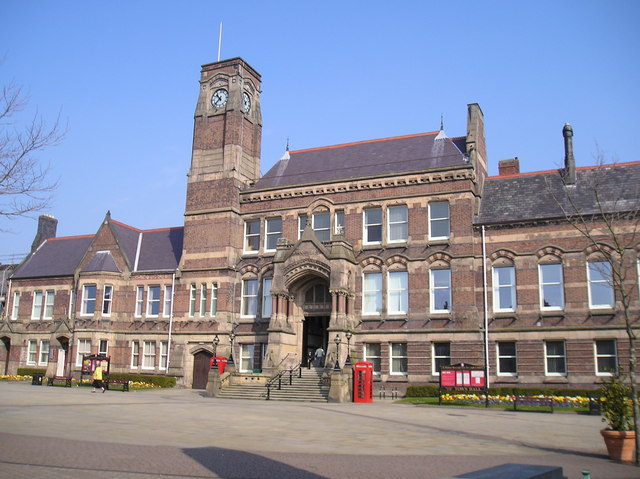
Location Image

District métropolitain de St Helens

Le district métropolitain de St Helens (en anglais : Metropolitan Borough of St Helens) est un district métropolitain du Merseyside. Il porte le nom de sa principale ville St Helens et comprend les localités de Newton-le-Willows, Earlestown, Haydock, Rainhill, Eccleston, Clock Face, Billinge et Rainford. Le district est créé le 1er avril 1974, par le Local Government Act 1972. Il est issu de la fusion de l'ancien district de Saint Helens, avec les districts urbains de Hoydock, Newton-le-Willows et Rainford, des portions des districts urbains de Billinge-and-Winstanley et Ashton-in-Makerfield, ainsi qu'une partie du district rural de Whiston.

1. Liens externes

(en) Site du district de Saint Helens

1. Crédit d'auteurs

(en) Cet article est partiellement ou en totalité issu de l’article de Wikipédia en anglais intitulé « Metropolitan Borough of St Helens » (voir la liste des auteurs).

Portail de l’Angleterre

Nearby Places View Menu
Location Image
0 m

Metropolitan Borough of St Helens

The Metropolitan Borough of St Helens is a local government district with borough status in Merseyside, North West England. The borough is named after its largest settlement, St Helens. It is one of the six boroughs of the Liverpool City Region. Other towns and villages in St Helens include Earlestown, Rainhill, Eccleston, Clock Face, Haydock, Billinge, Garswood, Rainford and Newton-le-Willows.
Location Image
340 m

St Helens College

St Helens College is a further education college serving the borough of St Helens. In 2009/10 it had 2,193 full-time adult learners aged 16–18 plus another 585 part-time learners. It had 541 full-time adult learners (age 19+), plus another 3,215 part-time adult learners. The total number of enrolments in 2009/10, including 14-16, FE, foundation learning, entry to employment, adult learners, and apprenticeships was 11,408 benefit claimants. The College provides a wide range of both further and higher education programmes, including qualifications for City and Guilds, National Diplomas, National Awards, National Certificates and NVQs; it also offers honours and foundation degrees validated through established partnerships with universities, including Central Lancashire, Edge Hill, Huddersfield, Liverpool John Moores, Salford and Sheffield Hallam. There are a number of entry-level qualifications available. The college traces its foundation to 1896 when it was the town's Gamble Institute, created by philanthropic mayor Sir David Gamble to provide a home of education for the rising generations. After substantial growth and expansion, the institute became the town's Technical College in 1959 and merged with Newton College in 1986. The purpose-built Technology centre began construction the same year. St Helens College is a member of the Collab Group of high performing schools. A report following a 2006 Ofsted inspection awarded the college a Grade 2 (good).
413 m

St Helens power station

St Helens power station supplied electricity to the Borough of St Helens and the surrounding area from 1896 to the late 1960s. The power station was developed by the St Helens Corporation which operated it up to the nationalisation of the British electricity supply industry in 1948. It was redeveloped several times to meet the increased demand for electricity.
Location Image
430 m

Mill Street Barracks

Mill Street Barracks is a former military installation in St Helens, Merseyside that is currently used by the Sea Cadets.
Location Image
506 m

Church of St Mary, Lowe House

The Church of St Mary, Lowe House is a Roman Catholic Parish church situated on North Road in St Helens, Merseyside. The present church was founded in 1924 and staffed by the Society of Jesus until 1981. It is a Grade II listed building with Romanesque and Gothic features.