Location Image

Galerie d'art moderne de Glasgow

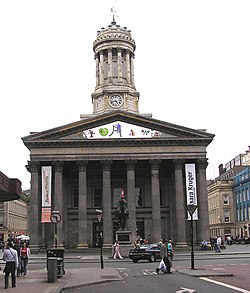
La Galerie d'art moderne (en anglais : Gallery of Modern Art, abrégé en GoMA, en écossais : Gailearaidh Ealaín Úr-nósach) est un musée d'Écosse, à Glasgow au Royal Exchange Square.

1. Histoire

Le Royal Exchange est créé en 1829 par l'architecte David Hamilton (1768–1843). Glasgow Corporation rachète le Royal Exchange en novembre 1949 pour 105 000 £ et le transforme en bibliothèque. Puis, la bibliothèque est déplacée pour laisser place à des expositions. À partir de 1992-1993, le conseil approuve un investissement de 10 millions de £ pour le transformer en musée. Le GoMA est ouvert depuis 1996. Les œuvres d'artistes contemporains locaux et internationaux y sont exposées.

1. Collections et expositions

Carlo Marochetti -"Statue du Duc de wellington" David Hockney Sebastião Salgado Andy Warhol John Bellany Ken Currie Anthony Green Beryl Cook Jo Spence (1934-1992) Ian Hamilton Finlay

1. Galerie


1. Notes et références


1. Voir aussi


1. = Articles connexes =

Liste de musées au Royaume-Uni Museum of Scotland Kelvingrove Art Gallery and Museum

1. = Liens externes =

Ressource relative aux beaux-arts : Art UK (lieux d'art) (en) Site officiel Portail des musées Portail de la peinture Portail de l’Écosse

Nearby Places View Menu
Location Image
308 m

Bridle Works Building

Bridle Works Building is a 20-storey student accommodation 68m high tower located at 366 Cathedral Street in Scotland's largest city, Glasgow. It is situated within walking distance of the city centre and to two of the city's three main universities, Glasgow Caledonian University and the University of Strathclyde. Housing 422 rooms, the building has its own tea lounge, glam room and rooftop terrace. The building was named in honour of Joan Eardley, a Glasgow School of Art graduate who had a studio in the area and who was famed for her paintings of oxen and horses. The building's aesthetic deliberately mimics elements of the 1960s Met Tower which stands diagonally opposite.
Location Image
425 m

Statue of Donald Dewar

A statue of the Scottish politician Donald Dewar stands on Buchanan Street in Glasgow city centre. The statue was unveiled on 7 May 2002 by the prime minister of the United Kingdom, Tony Blair. It was sculpted by Kenny Mackay. The statue is 9 feet in height. Dewar is depicted wearing spectacles and his "characteristic stoop and crumpled suit". The statue was unveiled on 7 May 2002 by the prime minister of the United Kingdom, Tony Blair in front of a crowd of several hundred people. At the unveiling of the statue Blair said that Dewar's " ... compassion, his fundamental decency and his deep sense of social justice defined his entire approach as a politician" and described him as a "transforming moderate". The former leader of Scottish Labour, Wendy Alexander, said that the statue was " ... magnificent, the setting and the angle of it ...It's wonderful but it's not what he was when he was at his most exhausted". The statue was taken down in October 2005 to be cleaned, and was re-erected on 6-foot (1.8 m) high plinth in December in an effort to protect it from vandalism.
426 m

Glasgay! Festival

Glasgay! Festival was a gay, lesbian, bisexual and transgender arts festival in Glasgow, Scotland. From 1993 to 2014, it was part of the diversity of Glasgow's cultural scene, an annual Lesbian, Gay, Bisexual and Transgender Arts Festival held usually in October/November, formerly organised by GALA Scotland Ltd.
Location Image
465 m

The Ramshorn

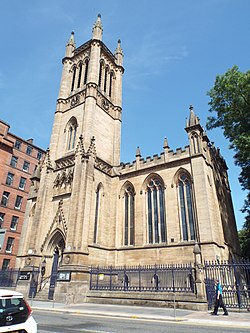
The Ramshorn (formerly St David's Parish Church), is a deconsecrated church building located on Ingram Street in the Merchant City area of Glasgow, Scotland. It is home to SCILT, Scotland's National Centre for Languages and the Confucius Institute for Scotland's Schools (CISS), both centres within the University of Strathclyde. The building is owned by the University, which bought the church in 1983 and used it as a theatre and performance space from 1992 until 2011. The former church building sits within the Ramshorn Cemetery, one of Glasgow's oldest burial grounds.
Location Image
479 m

Candleriggs

Candleriggs is a street in the city of Glasgow, Scotland. It is located in the Merchant City area of the city centre. Candleriggs was historically the area of the old city of Glasgow where candlemakers plied their trade, at a safe distance from the crowded tenements clustered around the High Street. As the city expanded in the eighteenth century it became a thriving thoroughfare itself, lined with tenements and businesses typical of Glasgow at that time. Looking down Candleriggs from its northern junction with Ingram Street, stands St David's, later known as Ramshorn Kirk. It had been without a congregation for a long while before being purchased by the University of Strathclyde in 1982. The church dates from 1826, built in Gothic Revival style by an English architect, Thomas Rickman, whose plans featured the large central tower which dominates the structure. It now serves as the home for the University of Strathclyde's Confucius Institute for Scotlands Schools and Scotland's National Centre for Languages. Candleriggs is perhaps best known as the site of the City Halls, a musical venue operated by Glasgow City Council, home to the BBC Scottish Symphony Orchestra and a regular Glasgow performance base for the Scottish Chamber Orchestra. It is the older purpose-built concert hall in Glasgow. The old Candleriggs Fruit Market building at the corner of Candleriggs and Bell Street housed a market for many years. With the opening of a purpose-built facility in May 1969, on the site of the old Blochairn Steelworks, it closed and was redeveloped as a complex housing pubs and restaurants which was renamed "Merchant Square". Towards the southern end of Candleriggs was the Goldbergs department store, which closed in 1991. It was then taken over by Vera Weisfeld (of What Every Woman Wants fame) and reopened in 1994 as Weisfelds - a budget clothing store. Weisfeld's closed in 1999. Granny Black's was a well known pub on Candleriggs housed in an old tenement building which collapsed due to a burst water main in the basement one night in February 2002. The building was empty at the time of the incident and there were no reported injuries. The site subsequently fell into dereliction and the land was acquired by the luxury retailer Selfridges of London, although their plans to build a department store there were later dropped. In late 2013, Selfridges began demolition of the former Goldbergs buildings and works began in early 2014 to landscape the area. Following Selfridges selling land to a property developer, approval was granted in May 2020 for mixed-use development of the site by Drum Property. The first phase of the development will include a 500-room hotel and 300 apartments and is currently under construction.