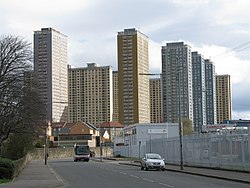
Provanmill is a district in the Scottish city of Glasgow. It lies to the north east of the city centre. In the mid-19th century it was a small hamlet with a grain mill, blacksmith's, cartwright's and hostelry. As Glasgow expanded, it became part of the city. Since the 1950s, the area became a major area of deprivation, with chronic housing and drug-related crime problems, although in the early 21st century the image of Provanmill and its surrounding areas is improving. Blackhill, one of the most notorious housing estates in the area, was demolished in 1990 to make way for the M80 Stepps bypass. Provanmill and Blackhill were known for being majority Irish Catholic and still to this day the demographics show that the areas, as well as nearby Royston (previously known as the Garngad), remain predominantly Catholic and still feature Irish republican marches annually. The area was also the home of infamous Glasgow gangster Arthur Thompson (a.k.a. "The Glasgow Godfather"). Provanmill's most famous landmark is the iconic twin gasometers of the now largely disused Provan Gas Works, which have become a portal into the city for motorists arriving on the adjacent M8 and M80 motorways.

Lieux à Proximité Voir Menu
Location Image
467 m

St Roch's F.C.

St Roch's Football Club is a Scottish football club, based in Royston Road, Glasgow. Nicknamed "the Candy Rock", they were formed in 1920 and play at James McGrory Park. They currently compete in the West of Scotland League First Division. They wear green and white strips. St Roch's was the first club of Jimmy McGrory, the British record goalscorer with 550 goals. McGrory, who grew up in the Garngad area where the club originated, began playing for them aged just 11. After helping the club win the Scottish Junior Cup in 1922, scoring in the final, he joined Celtic the following season.
570 m

Blackhill, Glasgow

Blackhill (Scottish Gaelic: Cnoc Dubh) is an area of north east Glasgow, Scotland. It is directly bordered by the M80 motorway to the west and the M8 motorway to the south. The neighbourhood falls within the North East ward under Glasgow City Council.
Location Image
814 m

Provan Gas Works

Provan Gas Works is an industrial gas holding plant in the city of Glasgow, Scotland. The plant lies between the Blackhill, Blochairn, Germiston and Provanmill areas of the city, and was built by Glasgow Corporation between 1900 and 1904. It later became part of British Gas, and subsequently Transco and most recently Scotia Gas Networks (previously a subsidiary of Scottish and Southern Energy) who operate it today. Originally the plant was a gasworks, manufacturing town gas via the cooking of coal. The plant was expanded after 1919. Following nationalisation of the gas supply in 1948, the plant passed to the Scottish Gas Board, and then to British Gas in 1973. In 1972, supplies of inexpensive natural gas from North Sea oilfields became available. The gasworks was downsized significantly in the 1980s in response to changing economic conditions arising as the British gas industry was privatised under Prime Minister Margaret Thatcher. Today the plant is largely unmanned, used solely for gas storage and distribution. The plant has become significant for its two massive column-guided gasometers and an additional spiral-guided gasometer, which have become an iconic industrial landmark in Glasgow's East End. Among the largest of their kind in the UK, each of the towers can hold 283,000 m3 (9,994,000 cu ft) of gas, and is 85.4 metres (280 ft) in diameter. Their combined storage capacity is 566,000 m3 (19,988,000 cu ft) – each enough to supply a city the size of York for an entire day. Since the construction of the M8 and M80 motorways in the 1970s and 1980s, which run directly next to the plant, the twin gasholders have become an unofficial portal into the city's central area for drivers from Edinburgh and the north. The towers have also gained an affectionate following among locals since they are often used to display huge placards showcasing the various promotional slogans for the city, the most memorable being the "Glasgow's Miles Better" and "Everyone's Glasgowing On" campaigns. The future of the plant is under discussion: Glasgow City Council have proposed plans for decontaminating the unused land on the brownfield site and redeveloping it for commercial use. In 2012, Scotia Gas Networks announced that the twin column-guided and single spiral-guided gasometers were to be decommissioned, with no decision made on their future. The twin column-guided gasholders were protected as Category B listed structures in 2018 by Historic Environment Scotland (with associated buildings on the site listed at Category C), a decision which the owners disputed due to the high maintenance costs involved, particularly when no longer being used for their originally designed purpose. However, the listed status (along with a pair of similar structures located in the city's Temple / Kelvindale area) was upheld after appeal, supported by local MP Paul Sweeney, who called for the creative reuse of the structures, citing other examples from around the UK such as Granton Gasworks in Edinburgh, and internationally such as Gasometer Vienna, Gasometer Oberhausen, Østre Gasværk Teater and Newstead Gasworks. In 2020, the Scottish Prison Service announced that it intended to buy 22 hectares (54 acres) of land adjacent to the gas works to build a replacement for HM Prison Barlinnie. Demolition of the unlisted spiral-guided gasometer began in 2020.
Location Image
858 m

Red Road Flats

The Red Road Flats were a mid-twentieth-century high-rise housing complex located between the districts of Balornock and Barmulloch in the northeast of the city of Glasgow, Scotland. The estate originally consisted of eight multi-storey blocks of steel frame construction. All were demolished by 2015. Two were "slabs", much wider in cross-section than they are deep. Six were "points", more of a traditional tower block shape. The slabs had 28 floors (26 occupiable and 2 mechanical), the point blocks 31 (30 occupiable and 1 mechanical), and taken together, they were designed for a population of 4,700 people. The point blocks were among the tallest buildings in Glasgow at 89 metres (292 ft), second in overall height behind the former Bluevale and Whitevale Towers in Camlachie, but still held the record for having the highest inhabitable floor and the highest floor count of any building constructed in the city. Views from the upper floors drew the eye along the Campsie Fells to Ben Lomond and the Arrochar Alps, then west past the Erskine Bridge and out to Goat Fell on the Isle of Arran continuing south over Glasgow and East towards Edinburgh. On a clear day, the buildings were visible on the Glasgow skyline from up to 10 miles (16 kilometres) away. The 31st floor of the point blocks and the corresponding 28th floor of the slabs were reserved as a communal drying area. Among the best-known of Glasgow's highrise housing developments of the 1960s, the buildings were formally condemned in July 2008 after a long period of decline, with their phased demolition taking place in three stages between 2010 and 2015.