Action at Lanark

The action at Lanark was an attack at Lanark, Scotland during the First War of Scottish Independence in May 1297. The Scotsman William Wallace led an uprising against the English and killed the Sheriff of Lanark, William Heselrig. The attack was not an isolated incident, but rather saw Wallace joining in with uprisings taking place across Scotland. Not much is definitely known about this incident. The best account comes from the Scalacronica by Thomas Grey, whose father, also called Thomas Grey, was present. A fracas broke out at a court being held by Heselrig, but Wallace was able to escape with help from an individual named Innes who may have been his wife. He then came back with some supporters and attacked Heselrig and his men, killed Heselrig, nearly killed Thomas Grey senior, and set fire to some houses. Wallace then continued with his rebellion, which culminated in his victory at the Battle of Stirling Bridge four months later. It is unclear what Wallace was doing at Heselrig's court, and whether this was a spontaneous incident or if it was co-ordinated with other risings in Scotland. According to the 15th century poem The Wallace, written by Blind Harry, Wallace carried out the attack in revenge for the killing of his beloved wife by Heselrig. Her name is traditionally claimed to be Marion Braidfute of Lamington. Harry also claims that Wallace dismembered Heselrig's body. Wallace biographer Ed Archer published his findings in 2005 that disputed the existence of Marion Braidfute, as there had been no mention of her prior to a revised rendition of Blind Harry's poem in 1570, believed by Archer to have been commissioned by the Baillies of Lamington, to gain favor with Mary, Queen of Scots by claiming relation to Wallace through their Braidfute lineage. Fictionalised versions of this incident have appeared in various accounts of Wallace's life, notably in the 1995 film Braveheart, in which his wife was called Murron MacClannough, and her execution preceded the battle.

Nearby Places View Menu
Location Image
1 m

Lanark

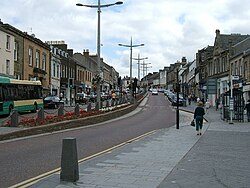
Lanark ( LAN-ərk; Scottish Gaelic: Lannraig [ˈl̪ˠaun̪ˠɾɪkʲ]; Scots: Lanrik) is a town in South Lanarkshire, Scotland, located 20 kilometres to the south-east of Hamilton. The town lies on the River Clyde, at its confluence with Mouse Water. In 2020, the town had a population of 8,880. Lanark was a royal burgh from 1140 to 1975, and was historically the county town of Lanarkshire, though in modern times this title belongs to Hamilton. Notable landmarks nearby include New Lanark, the Corra Linn and the site of Lanark Castle. Lanark railway station and bus interchange have frequent services to Glasgow. There is little industry in Lanark and some residents commute to work in Glasgow and Edinburgh. Its shops serve the local agricultural community and surrounding villages. There is a large modern livestock auction market on the outskirts of the town.
Location Image
221 m

Lanark Tolbooth

Lanark Tolbooth is a municipal building in Hope Street, Lanark, South Lanarkshire, Scotland. The building, which now operates as an arts and heritage centre, is a Category B listed building.
Location Image
247 m

St Nicholas Parish Church, Lanark

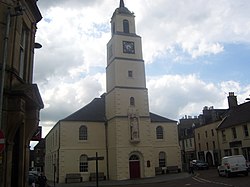
St Nicholas Parish Church is a category B listed building and Church of Scotland place of worship in the town centre of Lanark, South Lanarkshire, Scotland. The original 13th-century chapel was documented as early as 1890, however at that time it was claimed that there were no remnants of that building. A survey in the 1990s conducted by the Lanark and District Archaeological Society was able to find artefacts dating back to the 13th century, as well as 16th century pillars believed to have been constructed by Thomas Twaddle in 1571. Sources also reported evidence of the chapel's continued use in the medieval period and post-Reformation. Over the front entrance is an eight-foot-tall (approximately 2.4 meters) statue of William Wallace. This dates back to the early 19th century and was sculpted by Robert Forrest. In 2004, the remains of a well were found on the former grounds of the church during a routine ground breaking. There is documentation of the well's existence dating back to 1662; it was found in what is now Bloomgate, close to the church building, and was filled in after being drained and recorded. The church has had many ministers over the years, but has been left without a resident minister since 30 November 2014, when the incumbent Rev Alison Meikle left for Grangemouth Zetland.
Location Image
263 m

Lanark Sheriff Court

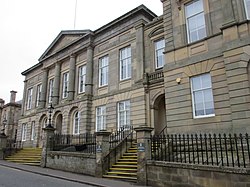
Lanark Sheriff Court is a judicial building in Hope Street, Lanark, South Lanarkshire, Scotland. The building, which continues to serve as the local courthouse, is a Category B listed building.