


The Union Auto Company is located in Eau Claire, Wisconsin. In 2007, the building was added to the National Register of Historic Places.
Location
2 explorers visited this place

69 m
Christ Church Cathedral, built in 1916 to replace the earlier 1874 building, is the Episcopal cathedral in Eau Claire, Wisconsin. It is one of the three cathedrals of the Episcopal Diocese of Wisconsin. It was formerly the mother church for the Episcopal Diocese of Eau Claire. The cathedral and parish house were added to the National Register of Historic Places in 1982.
The chancel and the parish house were designed by Minnesota architects Purcell, Feick and Elmslie in 1909. The nave of the church was designed by Purcell and Elmslie six years later. Their designs reflect their "use of English antecedents."
The cathedral has stained glass windows that a church pamphlet describes as 'among some of the finest in the country in richness and ecclesiastical style'. Six windows were designed by Heaton, Butler, and Bayne of London; others were supplied by Wippell Company of Exeter, England.
The parish house is a two-and-a-half-story stone and stucco building.
Also designed by Purcell and Elmslie is the Community House, First Congregational Church, also in Eau Claire, also listed on the National Register.
81 m
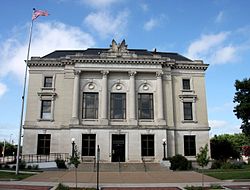
The U.S. Post Office and Courthouse in Eau Claire, Wisconsin, was built in 1907. It was listed on the National Register of Historic Places in 1991. It is designed in Classical Revival architecture style. Also known as Federal Building and U.S. Courthouse, it served historically as a courthouse and as a post office.

111 m
The Schlegelmilch-McDaniel House is a house-turned-museum in Eau Claire, Wisconsin. The house was built in 1871, one year before Eau Claire became a city. Today, the house, located at 517 S. Farwell St., directly across Farwell St. from the Christ Church Cathedral, is an exhibit of the Chippewa Valley Museum.

121 m
The Eau Claire Masonic Temple at the corner of South Barstow and Main Streets in Eau Claire, Wisconsin was built in 1899 and listed on the National Register of Historic Places in 2007.
In 1927 the Masonic bodies that met there relocated to their recently completed Temple of Free Masonry on Graham Avenue.
It is a three-story brick building. "The clearly visible pair of massive stone arches on the Barstow Street façade and other decorative elements distinguish the Masonic Temple as a fine example of H.H. Richardson-influenced Romanesque Revival architecture and one of the most architecturally significant buildings in the downtown area."
124 m
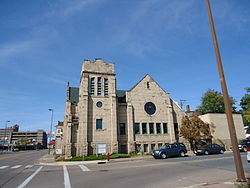
First Methodist Episcopal Church is a Neogothic Revival-styled church built in 1911 in Eau Claire, Wisconsin. It was added to the National Register of Historic Places in 1999 for its architectural significance.
The congregation that became First Methodist Episcopal began meeting in 1857, praying in the home of D.S. Hastings. Between 1863 and 1868, they built a wooden church on S. Barstow, and it served them until it burned in 1909. After the fire they met for two years in the Masonic Temple, until their new church was complete in 1911.
The 1911 building was designed by William Linley Alban and James E. Fisher of St. Paul and built by Samuel Converse and Company for $30,000, seating 650. The floor-plan is cross-gabled with a 3-story square tower in the corner. A foundation of rock-faced limestone supports walls of smooth-cut limestone blocks. Angle buttresses reinforce the corners, and the walls of the gable ends extend as parapets above the roof. One gable peak is topped with a cross. Features that mark the Neo-Gothic Revival style are the Gothic transoms over the doors, the steeply pitched roofs, and the irregular massing. Inside, some things have been changed, but the original pneumatic pipe organ built by W.W. Kimball and Company of Chicago still sits at the front of the sanctuary.
In 1930, First Methodist Episcopal merged with Lake Street Episcopal Church and moved to the larger building on Lake Street. The building was bought by Immanuel Lutheran, a Swedish Evangelical Lutheran congregation which had been founded in 1883. By 1930 they had outgrown their building on Oxford Ave. and Fulton Street, so bought First Episcopal's building. Immanuel stayed from 1931 to 1981, then sold it to the Unitarian Fellowship.
Book your tour near
Union Auto Company
→
History
The building was constructed for automobile sales and repairs. From 1917 to 1975, multiple auto-related businesses ran their operations from the site. In 1977, the upper portion of the building was converted into apartments and in 1980, what was once a showroom was converted into a bar and restaurant. Additionally, other parts of the building are now used for religious functions and the basement serves as a parking garage.
Book your tour near
Union Auto Company
Book Now
4.1
in partnership with
GetYourGuide.com
