


Xiaozhai station (Chinese: 小寨站) is a station on Line 2 and Line 3 of the Xi'an Metro. It is one of the busiest metro stations in Xi'an. It began operations on 16 September 2011.
Book your tour near
Xiaozhai station
Book Now
4.2
in partnership with
GetYourGuide.com
Location
2 explorers visited this place

797 m
The Xi'an Conservatory of Music is a music school located at Xi'an, Shaanxi, China. It is the only institution of higher music in the northwest of China.
860 m
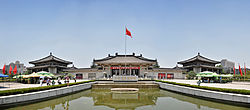
Shaanxi History Museum, which is located to the northwest of the Giant Wild Goose Pagoda in the ancient city Xi'an, in the Shaanxi province of China, is one of the first huge state museums with modern facilities in China and one of the largest. The museum houses over 370,000 items, including murals, paintings, pottery, coins, as well as bronze, gold, and silver objects. The modern museum was built between 1983 and 2001 and its appearance recalls the architectural style of the Tang dynasty.

1.1 km
Tiyuchang station is a station of Line 2 of the Xi'an Metro. It started operations on 16 September 2011.
1.1 km
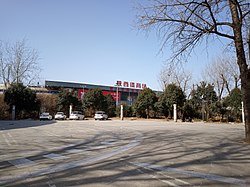
Shaanxi Province Stadium, also known as Zhuque Stadium because it is located near Zhuque Square, is a multi-use stadium in Xi'an, China. It is used mainly for football matches and athletics events. The stadium had a capacity of 50,100 people, but a renovation in 2020 reduced it to 43,000. It was named Coca-Cola Stadium from 2005 to 2007.
1.2 km
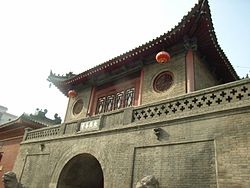
Daxingshan Temple is a Buddhist temple located in Yanta District of Xi'an, Shaanxi.
The temple had reached unprecedented heyday in the Tang dynasty, when Śubhakarasiṃha, Vajrabodhi and Amoghavajra taught Chinese Esoteric Buddhism in the temple, known as the "Three Prominent Buddhist Monks in the Kaiyuan Period". Then Japanese Buddhist monks Ennin and Enchin introduced it to Japan, since then, Daxingshan Temple became the cradle of Chinese Esoteric Buddhism. Daxingshan Temple, Daci'en Temple and Jianfu Temple became the three sutras translation sites in the Tang dynasty.
Daxingshan Temple was completely damaged in the Great Anti-Buddhist Persecution, after the fall of the Tang dynasty in 907, most parts of the temple were ruined in wars and natural disasters, and gradually it became unknown to public. Most of the present structures in the temple were repaired or built during the Ming dynasty and in modern China.
Book your tour near
Xiaozhai station
Book Now
4.2
in partnership with
GetYourGuide.com