


The Diocese of Norwich (Latin: Diœcesis Norvicensis) is a diocese of the Catholic Church in the states of Connecticut and New York in the United States. The mother church of the diocese is the Cathedral of St. Patrick in Norwich.
Gallery



Sponsored
Location
1 explorer visited this place

77 m
The Cathedral of Saint Patrick is a cathedral of the Roman Catholic Church located in Norwich, Connecticut., in the United States. It is the mother church of the Diocese of Norwich and is the seat of its prelate bishop.
371 m
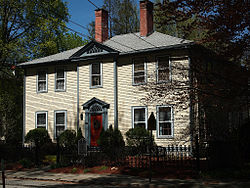
The Little Plain Historic District is a predominantly residential historic district located in Norwich, Connecticut. When originally listed in 1970, it was centered on Little Plain Park, located about halfway between modern downtown Norwich and the Norwichtown green, the colonial center of the town. From the late 18th century onward this area became a desirable and fashionable area to live, as it was closer to the growing port area of the city. The area was mostly built out by about 1875, and features a rich concentration of Greek Revival, Gothic Revival and Italianate houses, although older and later styles are also represented. The district was listed on the National Register of Historic Places in 1970 and enlarged in 1987. The 1987 enlargement expanded the district southward along Union Street and Broadway, to abut the Downtown Norwich Historic District, and increased the district's size from 30 acres to 38.8 acres.
Little Plain Park is a long and narrow triangular parcel bounded on the east by Broadway, the west by Union Street, and the south by Crossway Street. It was donated to the city by Deacon Jabez Huntington and Hezekiah Perkins, whose houses stand at 181 and 185 Broadway. Both are prominent examples of Georgian architecture to which Federal styling was later applied. The Dewitt-Sigourney House, at 189 Broadway, was built later in the 19th century for a ship's captain, and is a more pure example of Federal styling. The Woodhull and Johnson Houses at 167 and 171 Broadway are fine examples of Greek Revival architecture, built for merchants and ship owners.
The district includes buildings designed by Norwich architects James A. Hiscox and Joshua W. Shepard.
425 m
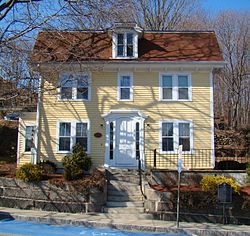
The Jail Hill Historic District encompasses a 19th-century working-class residential district in Norwich, Connecticut. Located on a steep hill overlooking downtown Norwich, it was populated first by African Americans, and then by Irish immigrants. Some early African-American residents played significant roles in bringing expanded rights and education to others. The district was added to the National Register of Historic Places on April 19, 1999.

438 m
The Telephone Exchange Building is a historic building at 23 Union Street in downtown Norwich, Connecticut, behind Norwich Town Hall. Built in 1906-07, it was the first purpose-built telephone exchange utility building in the city, and is a little-altered example of period exchanges built by the Southern New England Telephone Company. The building now houses city offices. It was listed on the National Register of Historic Places on November 28, 1983.

442 m
The Nathaniel Backus House is a two-story Greek Revival clapboarded house with a gable roof in Norwich, Connecticut. The house was built around 1750 by Nathaniel Backus and served as his home. It was moved to its current location in 1952. The house began as a Colonial structure, but it was greatly modified to Greek Revival around 1825, reconfiguring the central door to the left of the facade and adding two chimneys. It is a historic house museum operated by the Faith Trumbull Chapter of the Daughters of the American Revolution.
The Nathaniel Backus House was submitted to the National Register of Historic Places for its historical value in local history and as an example of Greek Revival domestic architecture. It was listed on the National Register of Historic Places in 1970 and was also included in the Chelsea Parade Historic District in 1989.