

 English
 Français

Cartland Craigs
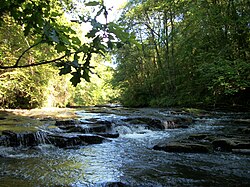
Cartland Craigs (known locally as Cartland Crags) is a woodland on the outskirts of Lanark, South Lanarkshire, in Scotland. It is a national nature reserve and is one of six areas which together form the Clyde Valley Woodlands (the other five being Cleghorn Glen, Falls of Clyde, Chatelherault, Nethan Gorge and Mauldslie Woods). The reserve is maintained by Scottish Natural Heritage. Cartland Craigs is adjacent to Cleghorn Glen and is the smaller of the two. The footpaths merge to form a 4.5 km walk. The Cartland Bridge is at the main Lanark entrance to the reserve and the Moose Bridge is between Cartland Craigs and Cleghorn Glen. The remains of the Castle Qua fort lie on the reserve and can be seen from the footpath.
Nearby Places View Menu
226 m
Castle Qua
Castle Qua (also known as Castle Quaw or Castle-dykes) is the name given to an earthwork found in the Cartland Craigs National Nature Reserve near Lanark, South Lanarkshire. It is site number NS84SE 1 in the records of the Royal Commission on the Ancient and Historical Monuments of Scotland. It's believed to be a medieval structure.

478 m
Cartland Bridge
Cartland Bridge is a road bridge on the A73 north-west of Lanark, South Lanarkshire which spans the Mouse Water, a tributary of the River Clyde. The three-span bridge was built in 1822, to designs by the engineer Thomas Telford. It is a category B listed building.
715 m
Mousemill Bridge
Mousemill Bridge is a crossing of the Mouse Water on Mousemill Road, just north of Kirkfieldbank. There are two bridges at the site, the present day road bridge and the old Mousemill Bridge which previously formed part of the road between Lanark and Hamilton through Kirkfieldbank but is today solely used by pedestrians.
1.0 km
Mouse Water
Mouse Water is a river in South Lanarkshire which is a tributary of the River Clyde. It is popular with canoeists. In the past, the fast flowing river was used to power mills and factories along its route and is still used today to produce hydroelectricity.